CS2 Skin Investing: The Complete Honest Guide
Heads up: CS2 skins are unregulated digital items, not investments or securities. Prices can fall sharply and Valve can change the rules at any time. Nothing here is financial advice — never spend money you can’t afford to lose.

Sukie · Founder & Market Tracker
Sukie has tracked the Counter-Strike skin economy since 2023, maintaining a price-history spreadsheet that covers 400+ skins and testing every major marketplace with her own inventory. She writes and updates every guide on CS2 Skin Prices herself.
Last updated: 2026-07-31
CS2 skin investing has grown from a side hobby into a market that analysts sized at roughly $6.7-8 billion in 2026, with around 27.9 million people holding at least one item and more than $15 million worth of items changing hands across marketplaces on a typical day. Numbers like that explain why players who once bought a skin just to look good in matches now talk about entry prices, catalysts, and exit targets. This hub organizes everything I have learned tracking this market since 2023 into one starting point, with links out to deeper guides on each topic.
Before any of that, the honest part. Skins are unregulated digital items, not securities. There is no oversight body, no deposit insurance, and no investor protection of any kind. Valve owns the platform, writes the rules, and can change drop rates, trading restrictions, or the supply of any item whenever it chooses — the October 2025 update proved that in a single afternoon. Prices can fall 30% in a week, money spent through Steam becomes wallet balance you can never withdraw as cash, and nobody is obligated to make you whole. Treat every dollar you put in as a dollar you can afford to lose completely, because you might.
With that on the table, the rest of this guide covers how the market actually works: the distinct asset classes hiding inside the word "skins," what genuinely moves prices, how to read the 2024-2026 cycle as a worked example, and the unglamorous discipline — position sizing, record-keeping, exit rules — that separates people who keep their gains from people who quietly give them all back.
Why Skins Behave Like an Alternative Asset Market
A skin produces no cash flow, pays no dividend, and has no book value. Its price is set purely by supply meeting demand, which puts it in the same family as trading cards, sneakers, and vintage watches rather than stocks or bonds. What makes the comparison surprisingly fair is that the supply side has real structure. Cases rotate out of active drops, wear tiers and float values make certain copies of a finish genuinely rare, and some items stop being produced altogether. The M4A4 Howl is the canonical example: after a copyright dispute in 2014, Valve made it Contraband, meaning no new copies can ever enter circulation. Factory New copies have traded in the low-to-mid five figures in recent years — not because the texture is magical, but because supply froze while the player base kept growing.
Demand comes from an enormous, engaged audience, and price discovery happens in public on the Steam Community Market, where every sale updates a visible history chart. Two frictions shape everything: Steam takes roughly a 15% cut of each sale, and proceeds land in a wallet that can only be spent on Steam. Those frictions are why the same skin often carries different prices on Steam versus cash marketplaces, and why fee math has to be part of every buying decision.
The Four Asset Classes Inside the Skin Economy
Talking about "skins" as one market is like talking about "real estate" as one market. In practice there are at least four distinct asset classes, and they behave differently enough that most bad decisions in this market come from applying one class's logic to another. You can browse live values for most of these on our skin price database.
| Asset class | Liquidity | Volatility | Typical hold horizon |
|---|---|---|---|
| Liquid mid-tier skins (roughly $20-150 rifles and pistols, e.g. AK-47 Redline) | High — usually sell within hours at a fair price | Moderate — moves with the broad market | Weeks to months |
| Cases (active and recently retired) | Very high — deep order books, near-instant fills | High — swung hardest of any class in 2024-2026 | Months to years |
| Discontinued and collectible items (old operation cases, Contraband items, souvenirs) | Low — thin listings and wide spreads | Low day-to-day, brutal during regime changes | Years |
| Knives and gloves | Low to medium — high prices mean fewer buyers per listing | Moderate — premium items fall slower but recover slower | Months to years |
Liquidity is the column beginners underrate. A knife that is "worth" $800 is only worth what a buyer pays this week, and on a thin order book that can mean accepting 10-15% below the chart price just to exit.
What Actually Drives Skin Prices
Once you strip away the noise, a handful of forces do almost all the work:
- Supply events. Updates that change drop pools, retire cases, or alter trade-up rules reprice scarcity overnight. These are the single biggest driver of large moves in both directions.
- Player counts. More active players means more demand for items. Concurrent player peaks are public on the official CS2 Steam page, and sustained growth there has historically supported the whole market.
- Hype cycles. Major tournaments, big content creators showcasing a loadout, and viral clips all pull short-term demand toward specific finishes. This demand is real but fickle.
- Opening economics. Case values are anchored by the odds inside them — a Covert drops about 0.64% of the time and a rare special item about 0.26%. Our case odds breakdown walks through why opening cases is entertainment, not acquisition strategy.
- Macro liquidity. When players collectively have less spare money — Steam sales draining wallets, broader economic squeezes — discretionary items feel it first.
Notice what is not on the list: the objective beauty of a skin. Plenty of gorgeous finishes are cheap because supply is abundant, and plenty of plain ones are expensive because it is not.
Reading Market Cycles: The 2024-2026 Arc
The last three years compressed a full market cycle into a case study worth memorizing. Through 2024 and 2025, case prices ran up dramatically as buyers treated retired cases like index funds — cheap, liquid, and seemingly guaranteed to appreciate as supply dwindled. The logic fed on itself, and by mid-2025 the appreciation had pulled in money that had never touched the game.
Then in October 2025, Valve shipped an update that expanded how Covert-tier items entered circulation. Scarcity assumptions that underpinned billions in paper value were repriced within days. The correction was steep and market-wide, and the community discussion on r/csgomarketforum widely described it as a "$1B wipeout." My own spreadsheet, which tracked over 400 items through that window, showed the combined paper value of its case positions falling faster in two weeks than it had risen in the previous four months.
Spring 2026 brought a recovery — but a selective one. Items with genuine scarcity and steady demand recovered much of the drawdown; items that had been riding pure momentum stayed down. That selectivity is the lesson: cycles here follow the classic shape of accumulation, hype, supply response, correction, and selective recovery. If you want the mechanics of the down-leg, the companion guide on why skin prices drop dissects each cause.
Position Sizing and Bankroll Honesty
The fastest way to get hurt in cs2 skin investing is not picking the wrong skin — it is putting in the wrong amount of money. A few rules have kept me sane since 2023. First, fund the hobby only from genuine discretionary money, the same budget you would spend on games or concerts, never from savings with a job to do. Second, cap any single item at a fixed slice of the total — I use 10%, so one bad thesis cannot sink the portfolio. Third, keep a meaningful share in the liquid mid-tier class, because the ability to exit quickly is itself a position. Fourth, decide your total exposure before a bull run, not during one; the strongest urge to oversize arrives precisely when prices are most stretched. Fifth, review your allocation quarterly against the four asset classes above — portfolios drift toward whatever ran hardest, which quietly concentrates exactly the risk you meant to spread. None of this guarantees anything, but sizing errors are the one mistake this market never forgives, because they turn a survivable 40% drawdown into a forced exit at the bottom.
A Note on Taxes and Records
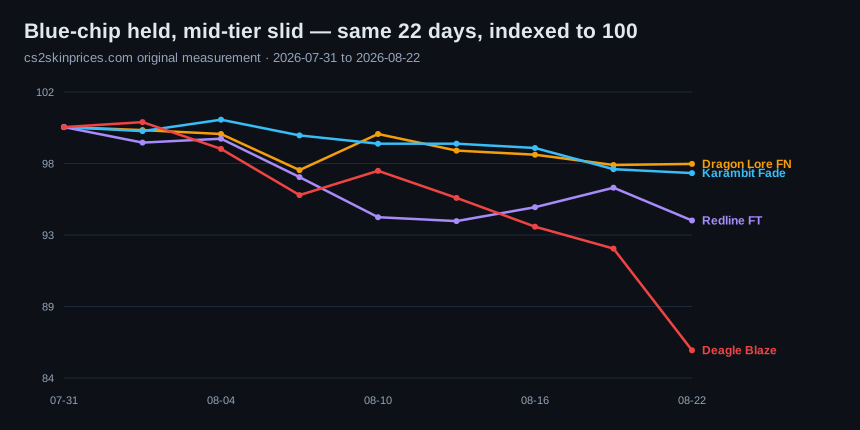
This surprises almost everyone: in many jurisdictions, selling digital items at a profit can be a taxable event, particularly when you cash out through third-party marketplaces to real money. Rules vary widely by country and situation, and nothing on this page is tax advice — but keeping records costs nothing now and is impossible to reconstruct later. Log every purchase and sale with dates, prices, and fees at minimum, and add a dated month-end snapshot of your inventory — it takes seconds and completes the picture. If your activity ever grows beyond pocket change, take that log to a tax professional in your jurisdiction and let them tell you what, if anything, applies. Good records also happen to be the foundation of every other discipline on this page, so the effort is never wasted.
How to Research an Item Before You Buy
Most losing purchases fail at the research stage, before any money moves. A pre-buy checklist that takes fifteen minutes:
- Pull twelve months of price history, not thirty days. A chart that only shows the recent run-up hides where the price lived before the hype arrived.
- Count listings. A rising price with rapidly rising listing counts means sellers are racing to distribute into strength — a warning sign.
- Understand the supply mechanics. Is the item still dropping? Could an update change that? Discontinued items only appreciate when shrinking supply meets sustained demand; scarcity alone does nothing if nobody wants the item.
- Name the catalyst. Write one sentence explaining why this item should be worth more later. A catalyst can be as simple as "this case left the active drop pool and supply is now finite" — but it must be specific enough to be proven wrong. If you cannot write it, you are guessing.
- Cross-check independent data. Third-party research like the SteamAnalyst 2026 market report is useful for sanity-checking whether your thesis matches broader flows.
- Be suspicious of bargains. A price far below market is usually bait. Our guide to common skin scams covers the patterns that separate a deal from a trap.
Exit Discipline: The Part Everyone Skips
Buying is fun; selling is where returns actually happen, and it deserves the same rigor. Start with fee-adjusted math: because Steam keeps about 15% of every sale, an item bought for $100 must list near $118 just to break even in wallet terms — and converting wallet value to cash through third-party routes typically costs another discount on top. Set your target price at purchase time, write it down, and treat hitting it as a decision point rather than a victory lap. Sell when the thesis completes or breaks, not when the chart makes you feel something. The two classic failures are anchoring — refusing to sell below a previous high the market no longer supports — and letting a winner become an oversized position by default. When you do pull the trigger, mechanics matter too; our walkthrough on how to sell skins covers timing, platform choice, and fee minimization. And log every exit in a tracker — the spreadsheet guide shows the exact setup I use — because your history of realized trades is the only honest teacher in this market.
Frequently asked questions
Is CS2 skin investing actually profitable?
It can be, and over 2024-2025 many holders did very well — but that window also created survivorship bias, because the people who bought the October 2025 top rarely post about it. After a 15% sale fee and the discount for converting to real cash, an item needs to appreciate meaningfully before you see genuine profit. Treat it as a hobby that might pay, not an income plan.
How much money do I need to start?
Less than most people assume. Fifty to a hundred dollars is enough to hold two or three liquid mid-tier skins and learn how pricing, fees, and selling actually work. The lessons from managing $75 are nearly identical to those from managing $7,500, and mistakes at the small scale are tuition rather than tragedy.
Why are Steam prices higher than cash marketplace prices?
Because Steam wallet funds can never be withdrawn as real money. A dollar locked inside Steam is worth less than a dollar in your bank account, so buyers on cash marketplaces demand a discount — often a substantial one. Always be clear which currency a price is denominated in before comparing.
Can Valve change or remove my items?
Yes, and it has. In 2014 the M4A4 Howl was made Contraband over a copyright dispute, and the October 2025 update changed Covert-tier supply overnight. Every item you hold exists inside a platform one company fully controls, which is a core reason skins carry risks that regulated assets do not.
Do discontinued cases always go up in value?
No. Discontinued items appreciate only when shrinking supply meets sustained demand — scarcity by itself does nothing. Older operation cases did appreciate impressively over the years, which is exactly why the 2024-2025 run treated them as a sure thing, and exactly why the October 2025 correction hurt so many holders who assumed the trend was automatic.
Isn't opening cases a way to invest?
The odds say otherwise: a Covert-tier skin drops roughly 0.64% of the time and a rare special item about 0.26%. Opening is entertainment with a steep expected loss, and if a specific skin is what you want, buying it directly on the market is almost always cheaper. This site does not encourage treating case opening as a money-making strategy.