Your First CS2 Skin: What to Buy, Where, and for How Much

Sukie · Founder & Market Tracker
Sukie has tracked the Counter-Strike skin economy since 2023, maintaining a price-history spreadsheet that covers 400+ skins and testing every major marketplace with her own inventory. She writes and updates every guide on CS2 Skin Prices herself.
Last updated: 2026-07-31
Buying your first CS2 skin is a small purchase that teaches you the entire economy in miniature: budgets, marketplaces, wear ratings, float values, price charts, and fees all show up in one $5 transaction. Get the habits right on that first buy and every later one — the $50 rifle, the eventual knife — follows the same playbook.
This guide is deliberately practical. It walks through the decision in order: set a number, pick a venue, learn to read one listing properly, then choose from a shortlist of skins that beginners consistently keep rather than regret. It ends with the two things almost nobody tells new buyers — what not to buy, and how to check afterward whether you paid a fair price.
One disclosure on prices: every figure here is approximate and hedged to mid-2026 levels, because skin prices move daily. Treat them as landmarks, not quotes, and always check the live chart before you click buy.
Decide Your Budget Before You Browse
The order matters: number first, shopping second. Browsing before budgeting is how a planned $10 purchase becomes a $60 one, because skin marketplaces are extremely good at showing you the next tier up.
Pick one of three lanes. $5 gets you one or two genuinely good-looking skins for the weapons you use most. $20 covers a full loadout — both rifles, a pistol, an AWP. $50 buys a loadout with one iconic centerpiece, like an AK-47 Redline. There is no lane below $5 worth bothering with as a first purchase, and no reason to go above $50 before you have watched the market for a few weeks.
Two structural facts should anchor the number. First, money that enters your Steam wallet never leaves Steam — you can spend it on games or skins, but you cannot cash it out to a bank. Second, if you later sell on the Steam Market, roughly 15% of the sale price goes to fees. Together those mean your first buy should be money you are fully content to convert into pixels and Steam credit. If you play regularly and do not yet have Prime Status (about $15 one-time), weigh that against a second skin — it gates the weekly drop system and holds its usefulness better than most skins hold their price.
Where to Buy: Steam Market vs Third-Party Marketplaces
For a first purchase, the Steam Community Market is the right answer for almost everyone. It sits inside Steam, delivery is instant and cannot be faked, every listing shows a full price history chart, and there is no account linking or API-key handoff that a scammer can exploit. The tradeoff is price: Steam listings typically run somewhat higher than third-party sites, and your money is committed to the Steam ecosystem the moment you deposit it.
Third-party marketplaces — the cash-based sites where players sell to each other — usually offer lower sticker prices and real-money payouts when you eventually sell. They are a legitimate part of the economy, and this site stays neutral on which, if any, to use. But they add moving parts a beginner does not need yet: seller reputation, delivery through trade offers, platform fees on both sides, and withdrawal rules. Every additional moving part is a place where the scams catalogued in our guide to CS2 skin scams operate.
The sensible sequence: make your first one or two purchases on Steam while you learn what listings look like, then evaluate third-party venues later if you start moving enough volume for the price gap to matter. On a $20 loadout, the difference is a dollar or two — cheap tuition.
How to Read a Listing Like You've Done This Before
Every listing has four things worth checking, in about thirty seconds total:
- Wear tier. The named condition: Factory New (float 0.00-0.07), Minimal Wear (0.07-0.15), Field-Tested (0.15-0.38), Well-Worn (0.38-0.45), Battle-Scarred (0.45-1.00). Field-Tested is the beginner value tier on most finishes.
- Exact float. Two Field-Tested copies are not equal — a 0.16 float looks close to Minimal Wear, a 0.37 looks rough. Our walkthrough on how to check CS2 float shows where to find this number before buying; a low-end float within your tier is free value.
- Pattern. On most budget skins the pattern seed is irrelevant. It matters on a handful of finishes (Case Hardened, Fade, Marble Fade) where the pattern changes the look — if a listing is priced far above its neighbors, pattern is usually why.
- Price history. Open the chart. If today's price sits well above the 30-day average, you are buying a spike; wait a few days. Flat charts mean fair entry.
Inspect in-game or via the inspect link when you can. Screenshots on wear-heavy skins hide scratches that the 3D inspect view reveals instantly.
Best First Skins Under $10
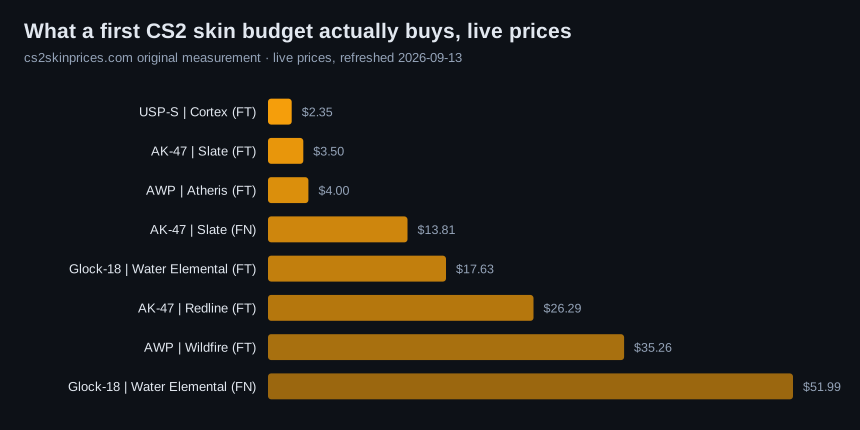
These five picks show up constantly in beginner loadouts for a reason: they look far more expensive than they are, they hide wear well in Field-Tested, and their prices have historically been stable rather than hype-driven. All prices are hedged mid-2026 levels for Field-Tested condition.
- AK-47 Slate (around $5). A clean, dark, all-business AK. Because the finish is a smooth gray-black, Field-Tested copies look nearly identical to Factory New — the classic example of paying less for the same visual.
- Glock-18 Water Elemental (around $4). The orange-and-teal wave design is one of the most recognizable pistol skins in the game, and you start every T-side round holding it, so it is the skin you will see most. High visibility per dollar.
- M4A1-S Nightmare (around $5). Purple horror-comic art on the most popular CT rifle. The silenced M4 hides wear well thanks to its dark base.
- AWP Atheris (around $4). The cheapest AWP skin that genuinely looks designed rather than dipped in paint — green snake motif, bold color blocking.
- USP-S Cortex (around $6). Skull-and-circuitry art on the pistol half the player base spawns with. Slightly pricier than the Glock pick, and worth it if you main CT sides.
Best First Skins from $10 to $50
Above $10 you are buying icons — skins with a decade of recognition behind them. Three that earn the step up:
- AK-47 Redline, Field-Tested (around $25 as of mid-2026). Probably the most beginner-recommended skin in Counter-Strike history: matte black with red racing stripes, instantly recognizable, and liquid — meaning it sells fast at a fair price whenever you want out. Redline only exists in Minimal Wear and below, so Field-Tested is the standard tier, not a compromise.
- AWP Chromatic Aberration, Field-Tested (around $25). A modern pick for AWP mains — glitch-art pinks and blues on the most attention-drawing gun in the game.
- Desert Eagle Mecha Industries, Field-Tested (around $10). The Deagle is the budget player's power weapon, and Mecha Industries' clean white-and-gray industrial look reads premium at a fraction of premium cost.
A useful habit at this tier: before buying, check how the same skin looks one wear tier up and down. Sometimes $8 more buys a visibly cleaner gun; sometimes it buys a number on a chart. Our Factory New vs Minimal Wear vs Field-Tested comparison (linked below) covers which skins reward the upgrade.
Three Budget Builds: $5, $20, $50
If you want the decision made for you, here are three complete builds at hedged mid-2026 prices. Each one is a set beginners actually keep — I built the $20 column for a friend in April 2026 and the total came to $19.40 on the Steam Market that week.
| Slot | $5 build | $20 build | $50 build |
|---|---|---|---|
| AK-47 | — | Slate FT (~$5) | Redline FT (~$25) |
| M4A1-S | — | Nightmare FT (~$5) | Nightmare FT (~$5) |
| Pistol | Water Elemental FT (~$4) | Water Elemental FT (~$4) | Cortex FT (~$6) |
| AWP | — | Atheris FT (~$4) | Atheris FT (~$4) |
| Deagle | — | — | Mecha Industries FT (~$10) |
| Reserve | ~$1 | ~$2 | ~$0 |
The $5 build is one great pistol skin plus patience — a legitimate start, since you see your pistol every round. The $20 build is the sweet spot. The $50 build adds the Redline as a centerpiece and a Deagle for eco rounds. None of these require luck, trades, or any site other than Steam.
What Not to Buy First
Three purchases consistently turn first-week enthusiasm into regret:
- Cases and keys. The math is unambiguous: a Covert (red) skin drops about 0.64% of the time, and a gold — knife or gloves — about 0.26%. At roughly $2.50 per key, opening until you hit a gold costs on the order of $900-1,000 in expected spend, for an item you could often just buy for less. Our full breakdown of CS2 case opening odds runs the numbers case by case. If the ritual appeals to you, budget one or two openings as entertainment and stop.
- Whatever spiked this week. When a skin goes viral — a pro plays it at a major on HLTV's front page, a YouTuber showcases it — its price front-runs the attention. Buying into a spike means someone who bought last month is selling to you at the top. Check the 30-day chart; if the line looks like a cliff face, wait.
- StatTrak as a default. StatTrak versions count your kills and cost meaningfully more. Fun later, but on a first budget the premium buys a counter you will not care about in a month, instead of a second skin you will.
Aftercare: Did You Overpay, and When Should You Sell?
After you buy your first CS2 skin, two follow-ups close the loop. First, the overpayment check: a day or two later, open the skin's price history and compare your buy price to the 30-day median. Within about 5%? You paid market rate — that is a pass, and now you know how to verify it for every future purchase. Paid a spike? Also fine — the tuition was a dollar or two, and the lesson permanently transfers to bigger buys.
Second, resist the urge to flip. Between the roughly 15% Steam Market fee and normal week-to-week volatility, a budget skin must rise 20%+ before selling returns more wallet credit than you spent — and wallet credit still is not cash. Budget skins are for using, not trading. Hold them, enjoy them, and revisit selling only when you are upgrading tiers; when that day comes, the mechanics and timing are covered in how to sell CS2 skins.
From here, two good next steps: the wider beginner's guide to CS2 skins maps the rest of the economy — drops, the Armory, price tiers, common mistakes — and the CS2 Skin Prices homepage tracks live prices on the skins named in this guide, so your landmarks stay current.
Frequently asked questions
What is the best first CS2 skin overall?
If you want a single answer: AK-47 Slate in Field-Tested, around $5 as of mid-2026. It goes on the game's most-used rifle, hides wear almost completely thanks to its dark finish, and has a history of stable pricing. If you main CT sides, the M4A1-S Nightmare is the equivalent pick.
Should I buy my first skin on Steam or a third-party site?
Steam, for the first one or two. Delivery is instant and unscammable, price history is built in, and there are no trade offers or API keys involved. Third-party marketplaces have real advantages on price and cash-out, but they add complexity that is not worth it on a $20 purchase while you are still learning.
Is Field-Tested too worn to look good?
On the right skins, no — and that is the whole trick. Dark, matte finishes like the AK-47 Slate and M4A1-S Nightmare look close to Factory New even at Field-Tested floats. Bright, glossy skins show wear much more. Check the specific float and inspect in 3D before buying, and favor copies near the low end of the 0.15-0.38 range.
Why shouldn't I just open cases instead?
Because the odds convert money to skins terribly: about 0.64% for a Covert and 0.26% for a knife or gloves, with most opens returning items worth far less than the key. Twenty dollars spent on cases usually yields a few blue skins worth under $2 total; twenty dollars on the Steam Market buys a full loadout you chose yourself.
Can I sell my first skin later if I stop playing?
Yes, at any time on the Steam Market, but expect roughly 15% in fees and remember the proceeds go to your Steam wallet, which cannot be cashed out to a bank. Liquid, well-known skins like the AK-47 Redline sell within hours at market price. Think of resale value as a discount on the fun, not an investment return.