CS2 Cases: How They Work, What They Cost, and When to Open One

Sukie · Founder & Market Tracker
Sukie has tracked the Counter-Strike skin economy since 2023, maintaining a price-history spreadsheet that covers 400+ skins and testing every major marketplace with her own inventory. She writes and updates every guide on CS2 Skin Prices herself.
Last updated: 2026-07-31
CS2 cases are the sealed containers that drop while you play Counter-Strike 2, and every one of them is a small economics lesson. Each case holds a single random skin from a fixed list, locked behind a $2.49 key, with odds Valve has published ever since Chinese regulators forced the disclosure back in 2017. What you do with those containers — open them, sell them, or let them pile up — quietly shapes what this hobby costs you every month.
I have tracked case prices in my spreadsheet since 2023, and in that time containers went from the most ignored drop in the game to one of its most-watched asset classes. This guide walks through where cases come from, what is actually inside them, why one sells for three cents while another sells for hundreds of dollars, and how a budget-minded player should decide what to do with the stack sitting in their inventory.
What a CS2 Case Actually Is
A case is an inventory item containing one random skin from a fixed, published list — usually around 17 weapon finishes spread across four visible rarity tiers, plus a hidden fifth slot for knives or gloves. The case shows you everything it can contain before you open it, which is more transparency than most loot-box systems offer. What it does not show you is which item you will get, and the distribution is steeply weighted toward the cheapest tier.
Opening requires a key, sold in-game for $2.49, and the animation reveals your item with the famous slowing ticker. Two details newcomers consistently miss. First, the wear value (float) of whatever you unbox is generated randomly at the moment of opening, not predetermined — the same skin can come out looking pristine or battle-scarred, and that difference can be worth real money. Our CS2 float chart breaks down exactly how those ranges work. Second, the unopened case itself is a tradable item you can list on the Steam Community Market, which is why containers have market prices at all — and why some players never open anything and simply sell every drop. Unlike skins, the containers themselves have no wear, no float, and no StatTrak variants; every sealed copy of a given case is identical, which makes them one of the simplest items in the whole economy to price and trade.
How You Get Cases: Weekly Drops, the Armory, and the Market
There are three faucets. The first is the weekly drop: level up once per week in Counter-Strike 2 by earning XP in official modes and you receive one random container from the active drop pool. The second is the Armory, added in October 2024, which lets you redeem stars earned through XP for specific items — the Gallery Case debuted through it, and the Fever Case followed as an Armory redemption in March 2025. Between the level-up drop and Armory redemptions, two CS2 cases per week is a realistic ceiling for a free-to-play grinder.
The third faucet is simply buying containers on the market, where active-pool cases often cost less than a dollar. That option matters more than people think: if you enjoy the opening ritual, buying five cheap containers costs pocket change compared to the keys you will put in them. And if you do not enjoy it, the market runs in the other direction — every drop you receive converts to wallet funds in about thirty seconds. Neither path requires you to touch anything outside Valve's official ecosystem, which is the only place this site covers.
The Official Odds Inside Every Container
Valve publishes exact rarity odds, a disclosure that dates to 2017, when China's regulator required loot-box probability publication and Valve applied the numbers globally. Every standard weapon case uses the same distribution, documented in SteamAnalyst's case odds guide:
| Rarity tier | Color | Official odds | Roughly one in... |
|---|---|---|---|
| Mil-Spec | Blue | 79.92% | 1.25 cases |
| Restricted | Purple | 15.98% | 6.3 cases |
| Classified | Pink | 3.20% | 31 cases |
| Covert | Red | 0.64% | 156 cases |
| Special (knife/gloves) | Gold | 0.26% | 385 cases |
That last row deserves a hard look. At 0.26%, the expected wait for a knife or gloves is about 385 opens — roughly $958 in keys alone before you count the cases themselves. Within each tier, StatTrak versions make up about 10% of drops. If you want the full probability math, including what those odds mean over 10, 100, or 1,000 opens, our guide to CS2 case opening odds works through every number.
Key Economics: The $2.49 That Changes Everything
Keys cost $2.49 and can only be bought in-game. Since 2019 they cannot be traded or listed on the market — Valve locked them down after concluding that nearly all key trading had become a fraud vehicle. The consequence for you is simple: the key is a hard, non-negotiable floor under every single open. A three-cent container still costs $2.52 to reveal. A hundred opens cost $249 in keys before you have bought a single case.
This is why "cheap case" thinking misleads people. When someone compares a $0.40 container to a $2.80 one, they instinctively see a 7x price difference. In cost-per-open terms it is $2.89 versus $5.29 — less than 2x — because the key dominates the bill. It also explains a quirk my spreadsheet makes obvious: case prices can swing wildly with hype cycles, but the total cost of an opening habit barely moves, because Valve's fixed key price anchors it. Any honest budgeting for this hobby starts with keys, not cases.
Put the habit on an annual footing and the numbers get clarifying. Two opens a week — the free-drop ceiling — runs about $259 a year in keys alone. Ten opens a month is roughly $299 in keys plus whatever the containers cost. Neither figure is scandalous for a hobby, but both are far more than most players guess when asked, because $2.49 at a time never feels like anything. Write your number down before you open; it is the cheapest discipline in this whole economy.
Active vs. Discontinued: Two Very Different Price Stories
Every container lives one of two lives. While it sits in the active drop pool, fresh supply arrives every week from millions of players, and the price stays pinned low — often under a dollar. When Valve rotates it out, the faucet closes but the drain keeps running: every open permanently destroys one case. Shrinking supply against steady demand grinds the price upward for years, which is why discontinued CS2 cases from the mid-2010s now trade for many multiples of what anyone paid during their drop window.
| Case type | How you get it | Typical price behavior |
|---|---|---|
| Active drop pool | Weekly XP drop, Armory redemptions, market | Cheap and stable; constant new supply caps the price |
| Rare / discontinued | Market only; no longer drops | Grinds upward long-term as opens destroy supply |
| Souvenir package | Dropped to viewers during Majors; market afterward | Event-limited supply; collectible behavior, spiky around Majors |
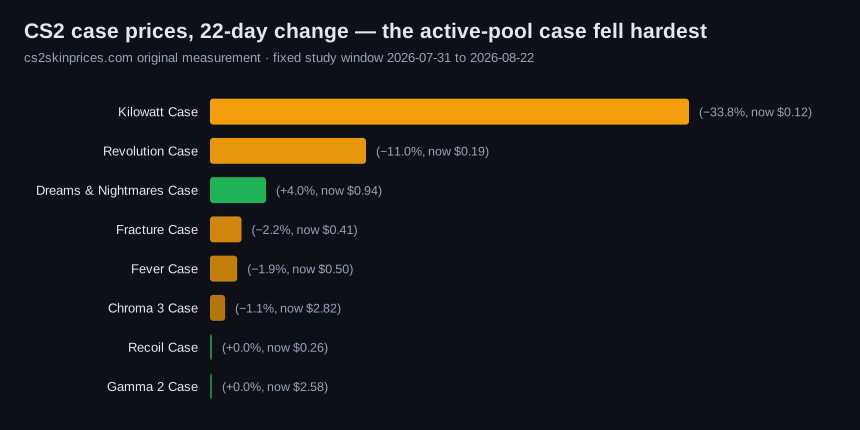
The lesson for a budget player: the case in your inventory today is likely at the cheapest point of its life. One dated example from my own tracking makes the pattern concrete — the Kilowatt Case entered the drop pool in February 2024 at pocket-change prices and sat there for months, exactly as active-pool economics predict, while older rotated-out containers on the same spreadsheet tab kept grinding upward quarter after quarter. Whether that argues for selling your drops now or holding them for years depends mostly on your patience, which we get to below.
Souvenir Packages Are a Different Animal
Souvenir packages look like cases but play by different rules. They drop only to people watching Major championship matches during the event window — the tournament calendar on HLTV tells you when those windows open — and they contain skins from the map collections played at that Major, stamped with gold stickers of the event and the teams or players in that match.
Three differences matter. First, no key: souvenir packages open free, which makes them the only container in the game without the $2.49 floor. Second, no knives or gloves — the ceiling is a rare souvenir version of a collection skin, some of which are genuinely expensive, most of which are not. Third, supply is capped forever by how many dropped during one specific event, which gives them collectible dynamics closer to trading cards than to weapon cases. A souvenir package from an old Major is a small historical artifact, and the market prices it that way. If you catch one during a Major, my honest suggestion is to look up what it sells for sealed before you even think about the ripcord. The gap between a sealed package's collectible value and the median value of what is inside it is usually wide, and it only widens as the event recedes into history.
How Case Prices Became an Investment Class (2024–2026)
Something shifted in the container market over the last two years. Player counts climbed, case-opening content boomed, and buyers started warehousing cheap containers by the thousands on the theory that today's active case is tomorrow's discontinued collectible. Demand for containers spiked hard through 2025, and my own spreadsheet caught it directly: a basket of ten active-pool containers I have logged weekly since early 2024 roughly tripled in average price between January and December 2025, with the sharpest moves following each rotation announcement. SteamAnalyst's 2026 market report documents the same pattern across the broader market.
Two cautions before you treat containers as a savings account. Rotation timing is entirely Valve's call and has never been predictable — a case can sit in the drop pool for years, suppressing its price the whole time. And what spikes can unwind; the same crowd psychology that tripled prices can run in reverse, a dynamic covered in our guide to why CS2 skin prices drop. Cases have been a strong trade recently. That is not the same thing as a safe one.
Open, Sell, or Hold: A Simple Decision Framework
Here is the framework I actually use, in priority order.
- Wanting a specific skin? Buy it directly. Opening is almost always negative expected value — you will typically get back a fraction of what the key and case cost. If the goal is a particular finish on your rifle, the market sells it outright for less than the average cost of gambling your way to it. Start with the price-checking basics on our CS2 skin prices homepage if you have never bought a skin before.
- Opening for fun? Budget it as entertainment. A few opens a month as a ritual is a legitimate hobby expense, the same way a movie ticket is. Pick containers that maximize the show — our ranking of the best CS2 cases to open compares them on exactly that basis.
- Selling? Mind the 15%. The Steam Market takes a 15% fee on every sale, and proceeds stay inside Steam. Selling active-pool drops nets you cents; that is fine, cents compound.
- Holding? Cost is zero, so patience is cheap. Containers take no upkeep. If you do not need the pennies today, holding drops until rotation is the laziest reasonable strategy — see our guide to selling CS2 skins when the time comes.
None of these paths involve third-party opening or gambling sites, which offer worse transparency than Valve's published odds and no buyer protections. Official cases, official market, eyes open — that is the whole playbook.
Frequently asked questions
Are CS2 cases worth opening?
Financially, almost never — across the official odds, the average open returns well under half of what the key and case cost, which is why buying a skin directly beats opening your way to it. Opening is worth it only as entertainment you have budgeted for, the way you would budget for any night out. If you enjoy the ritual, keep it small and use cheap active-pool containers.
How many cases can you get per week in CS2?
Two is the realistic ceiling for most players: one random container from your weekly XP level-up drop, plus whatever you redeem through the Armory. Beyond that, the only source is buying containers on the Steam Community Market, where active-pool cases usually cost well under a dollar.
Why are some old cases so expensive?
Because supply only shrinks. Once a container leaves the active drop pool, no new copies enter the economy, while every open permanently destroys one. Years of that one-way flow, combined with the collector demand that built through 2024-2026, is why discontinued containers can cost hundreds of times their original drop-era price.
Can you get a knife from any CS2 case?
Almost any standard weapon case includes a gold-tier slot at 0.26% odds, but the specific knives or gloves inside differ by case — each container has its own special-item pool. Souvenir packages are the exception: they contain no knives or gloves at all, only souvenir versions of map-collection skins.