CS2 Skin Market Value: How Big the Economy Really Is, and How to Value Your Own Inventory
Heads up: CS2 skins are unregulated digital items, not investments or securities. Prices can fall sharply and Valve can change the rules at any time. Nothing here is financial advice — never spend money you can’t afford to lose.

Sukie · Founder & Market Tracker
Sukie has tracked the Counter-Strike skin economy since 2023, maintaining a price-history spreadsheet that covers 400+ skins and testing every major marketplace with her own inventory. She writes and updates every guide on CS2 Skin Prices herself.
Last updated: 2026-09-11
Ask what the CS2 skin market value is and you will get answers ranging from a few hundred million dollars to comfortably over eight billion, all delivered with equal confidence. Both ends of that range are defensible, because they are measuring different things — and nobody quoting the figure usually says which. This page separates the three quantities that get muddled together, explains which one is actually knowable, and then does the more useful thing: shows you how to put a defensible number on your own inventory, which is the question most people are really asking.
The short version, if you only want one line: the total notional value of every CS2 skin in existence is an estimate built on unpublished data and should be treated as a rough order of magnitude. The value of your inventory is knowable to within a few percent, and most people overstate it by 20–30% because they price it wrong.
Three different numbers people call the market value
1. Total notional inventory value. Every skin in every account, multiplied by some reference price, summed. This is the number that produces the eight-billion-dollar headlines. It is an estimate on top of an estimate: Valve does not publish how many of each item exist, so researchers infer circulating supply from unboxing rates, drop rates and sampled inventories, then multiply by a price that is itself contested. Directionally interesting, precisely meaningless. Treat any specific figure in this category as an order of magnitude and nothing more.
2. Annual traded volume. How much money changes hands in a year across Steam Community Market and third-party venues. This is a much better-grounded number, because marketplaces know their own throughput, though only some publish it and Steam does not break it out. It also measures something more economically meaningful: notional value is what people hold, traded volume is what the market can actually absorb.
3. Liquid market value. What could be sold, at roughly current prices, without collapsing the price. This is the smallest of the three by a wide margin and the one almost nobody quotes, because it is the least flattering. My own data illustrates why: the AWP Dragon Lore in Factory New listed at $11,023 at the 13 September 2026 refresh, but there is not a queue of buyers at that number. Sell three of them in a week and you would find the fourth one considerably harder.
When someone tells you the skin market is worth $X, ask which of these three they mean. Usually the answer is that they have not distinguished them, and the number is doing rhetorical work rather than analytical work.
The one publicly verifiable component is per-item sale volume, published free by Valve on every Steam Community Market listing page. Those volume bars are completed sales, not listings, which makes them the only ground truth available without a marketplace partnership.
There is a fourth figure occasionally cited — the total value of items opened from cases, which some sites reconstruct from published drop rates. It has the same inference problem as the first number, compounded by the fact that opened items are immediately double-counted in circulating supply. I would not build any decision on it.
What can you actually rely on? Two things. Marketplace-published volume figures, where they exist, because the venue has no incentive to inflate a number that determines its own fee revenue reporting. And Steam's per-item sale volume bars, visible on any market listing page, which tell you how many copies of a specific item genuinely traded on a given day. That second source is free, item-level, and vastly underused. It is the closest thing to ground truth in this hobby.
Why your inventory is worth less than the tool says
Inventory valuation tools typically multiply each item by its lowest current listing or by a blended "suggested" price. Both overstate what you would actually receive, for four compounding reasons.
Fees. Steam takes a combined 15% and its balance cannot be withdrawn as cash. Third-party venues charge less but still charge. A $100 inventory priced at listing value nets somewhere between $80 and $92 depending on where you sell — before anything else goes wrong. Our marketplace comparison has the current fee structures.
You sell into the bid, not the ask. The listing price is what a seller is asking. To sell quickly you must undercut the current floor, which means the realistic figure is a few percent below the number your tool shows, not at it.
Float and pattern cut both ways, and tools ignore both. A valuation tool sees "AK-47 | Redline (Field-Tested)" and applies one price. But a 0.16 float copy and a 0.37 float copy are meaningfully different items — and in my tracked data Redline Minimal Wear was $126.46 against Field-Tested at $26.29, a 4.81× gap across a boundary that a sloppy tool can get wrong entirely if it matches on skin name alone.
Thin items do not clear at the listing price. For anything above roughly three figures, the listing floor can sit unchanged for weeks with no sale behind it. Our CS2 skin price history page documents an AWP Asiimov whose floor read $81.67 on one sample and $104.69 three days later, with no market event in between — that is what a thin book does to a price you were relying on.
Put together, my rule of thumb is to take the tool's number and subtract 20% for a realistic quick-sale figure, or 12–15% for a patient sale on a low-fee venue. That is not pessimism; it is the arithmetic of fees plus spread.
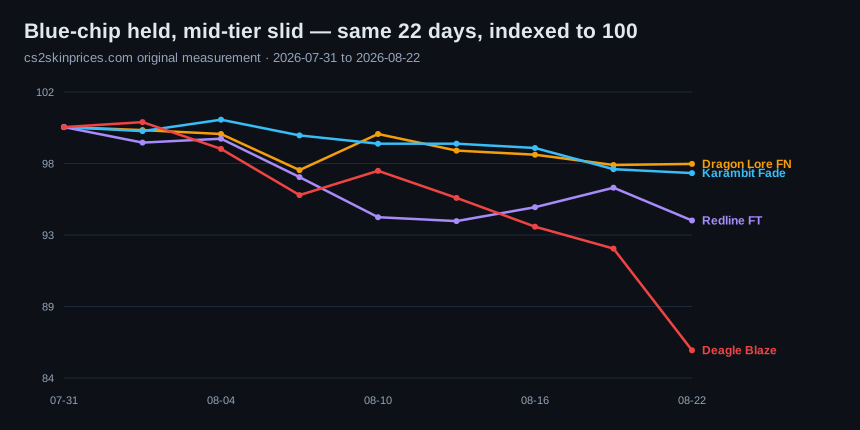
There is a fifth factor that only bites at the top of an inventory, and it catches people who own one item worth more than everything else combined. Concentration risk is not a valuation adjustment so much as a liquidity one: if 70% of your stated inventory value sits in a single four-figure knife, your inventory is not worth what the tool says in any practical sense, because realising it means finding one specific buyer rather than twenty ordinary ones. In my tracking the four-figure items were the steadiest by percentage — the Karambit Fade moved 2.9% across three weeks — but steadiness in the quoted price is not the same as being able to convert it.
A method you can actually defend
Here is the process I use, which takes about twenty minutes for a normal inventory and produces a number I would be willing to state out loud.
- List every item by full market hash name, including the wear. Not "Redline" —
AK-47 | Redline (Field-Tested). This single step eliminates the most common valuation error. - Record the float for anything worth more than about $20. Position within the wear band moves value materially on pale skins and on anything near a tier boundary. Our float checking guide covers the free tools.
- For each item, take the lowest listing and the median of the first five listings. When the two are far apart, the floor is one seller and the median is the better estimate.
- Check Steam's sale volume bars. If an item shows near-zero recent volume, discount it further regardless of its listed price — you cannot sell into a market that is not trading.
- Apply the fee for the venue you would actually use, not the best fee available in theory.
- Re-run it on a schedule and keep the history. A single valuation is a snapshot; a series tells you whether your inventory is tracking the market or diverging from it. Our CS2 skin price tracker page has the build, and the investment spreadsheet has the column layout.
One piece of context for whatever number you land on. Between 31 July and 22 August 2026 I tracked 56 items every three days: 47 fell, median −5.6%. If your inventory value dropped about six percent over a comparable window, nothing happened to your inventory — the market moved and you moved with it. Distinguishing those two situations is the entire practical value of doing this properly.
And the obligatory honest caveat, which the investing hub repeats for good reason: skin values are set inside a market whose supply is controlled by one company that does not pre-announce its decisions. Nothing here is financial advice, no valuation method predicts the next case removal, and money you cannot afford to lose does not belong in a virtual-goods market. Start from the live price board if you want current figures for the items above.
Frequently asked questions
How much is the CS2 skin market worth?
Estimates range from hundreds of millions to over eight billion dollars, because they measure different things. Total notional inventory value is the biggest and least reliable figure, since Valve does not publish circulating supply. Annual traded volume is better grounded, and liquid market value — what could actually be sold without moving prices — is far smaller than either.
Why do CS2 market value estimates differ so much?
Because the underlying supply data is not published. Researchers infer how many of each item exist from drop rates and sampled inventories, then multiply by a contested reference price. Small differences in either assumption compound into billions.
How do I find the value of my CS2 inventory?
List every item by full market hash name including wear, record floats for anything above about $20, take both the lowest listing and the median of the first five listings, check Steam's sale volume bars, and subtract the fee for the venue you would actually sell on.
Why is my inventory worth less than the valuation tool says?
Four reasons stack: marketplace fees of up to 15%, the need to undercut the current floor to sell, tools ignoring float and pattern, and thin items whose listing price has no recent sales behind it. Subtracting 20% from a tool's figure is a realistic quick-sale estimate.
What is the difference between notional and liquid skin market value?
Notional value is every skin multiplied by a reference price. Liquid value is what could actually be sold at roughly current prices without collapsing them. For high-value items the gap is enormous, because there is no queue of buyers at the listing price.
Does Steam publish CS2 market volume data?
Not as an aggregate figure, but it does publish per-item sale volume bars on every market listing page. That item-level data is free, reflects completed sales rather than listings, and is the closest thing to ground truth available publicly.
How often should I revalue my CS2 inventory?
Monthly is enough for most people, and the value comes from keeping the history rather than from any single valuation. A series lets you tell whether your inventory is tracking the market or diverging from it.
Does float value affect inventory valuation?
Materially, on anything above about $20 and on any item near a wear-tier boundary. Most valuation tools match on skin name and wear label only, which ignores the substantial price differences within a single wear band.
Is the CS2 skin market growing?
Over the long run it has grown alongside the player base, but it moves in cycles and can fall hard. In my own 22-day sample across 56 items in August 2026, 47 items fell with a median change of −5.6%. Short windows tell you very little about direction.