CS2 Float Chart: Every Wear Range, What It Looks Like, and What It Costs

Sukie · Founder & Market Tracker
Sukie has tracked the Counter-Strike skin economy since 2023, maintaining a price-history spreadsheet that covers 400+ skins and testing every major marketplace with her own inventory. She writes and updates every guide on CS2 Skin Prices herself.
Last updated: 2026-07-31
Here is the CS2 float chart you came for, straight away: five wear tiers, five number ranges, and a price curve that punishes buyers who only read the tier name. Every skin in the game carries a fixed wear number between 0.00 and 1.00, and the tables below show exactly where each named tier begins and ends, what the wear actually looks like on the weapon, and how the numbers translate into dollars — including three worked examples at 0.03, 0.16, and 0.45 so you can practice reading a listing the way an experienced buyer does.
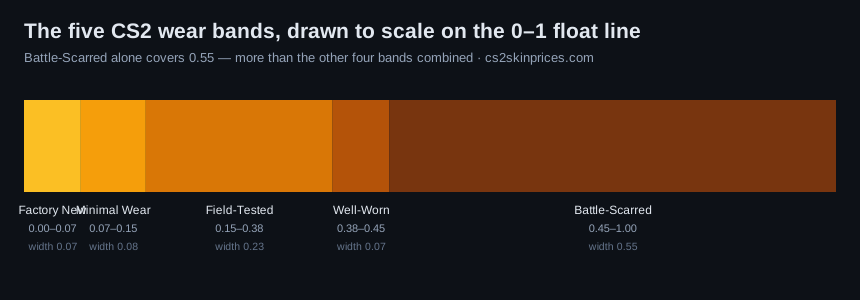
The Master CS2 Float Chart
These five ranges are fixed by the game and identical for every skin that uses the full scale (capped skins are covered at the end of this guide). The availability and price columns reflect what I see across the 400+ skins in my tracking spreadsheet as of mid-2026.
| Wear tier | Float range | Share of scale | Typical availability | Typical price vs Field-Tested |
|---|---|---|---|---|
| Factory New | 0.00 - 0.07 | 7% | Scarce for most skins | +50% to +150% |
| Minimal Wear | 0.07 - 0.15 | 8% | Moderate | +15% to +45% |
| Field-Tested | 0.15 - 0.38 | 23% | Abundant | Baseline |
| Well-Worn | 0.38 - 0.45 | 7% | Thin supply, thin demand | -10% to -25% |
| Battle-Scarred | 0.45 - 1.00 | 55% | Abundant | -15% to -40% |
Two things jump out. First, the tiers are wildly unequal: Battle-Scarred spans more than half the entire scale, so two BS copies can look like different skins. Second, the number is assigned once, at unboxing, and never changes — a fact BLAST's wear guide explains in detail. Memorize the two borders that matter most for your wallet: 0.07 and 0.15.
What Each Wear Tier Looks Like Up Close
Numbers are abstract until you know what they do to the paint. This table describes the typical visual state at each tier for a standard full-range finish; exact behavior varies by skin, which is why the worked examples below matter.
| Wear tier | Where wear appears | Overall impression |
|---|---|---|
| Factory New | Essentially nowhere; at most a faint mark on a hard edge | Showroom clean |
| Minimal Wear | Light scuffs on corners, magazine edges, and the barrel tip | Clean at a glance, minor wear on inspection |
| Field-Tested | Visible scratches across the body, paint loss along edges | Clearly used but presentable |
| Well-Worn | Large faded patches, heavy edge wear, dulled colors | Rough |
| Battle-Scarred | Widespread paint loss, bare metal along barrel and body | Heavily stripped, sometimes barely recognizable |
A useful habit: wear concentrates on edges and high-contact points first, then spreads inward. That is why a 0.16 can pass for Minimal Wear at gameplay distance — the early damage hides on parts of the gun you rarely look at while playing.
Finish style changes how harshly the chart bites, too. Glossy, detailed finishes like the Printstream or Asiimov telegraph every scratch, while matte and pattern-based finishes such as Case Hardened blues disguise wear so well that a mid-FT copy can look nearly as good as MW. Before paying a wear premium, ask whether this particular finish even shows its wear.
Reading a Float Like a Buyer: Three Worked Examples
Here is how I actually use the chart when a listing is in front of me.
Example 1 — a 0.03. This sits comfortably inside Factory New, well clear of the 0.07 border. On an M4A1-S Printstream, a 0.03 looks identical in-game to a 0.005, yet collectors pay steep premiums for the extra zeros. Unless you are collecting, the middle of FN is the smart end of it: you get the pristine look without funding someone's vanity-number premium.
Example 2 — a 0.16. Just inside Field-Tested, one hundredth above the Minimal Wear border. This is the single best value zone on the whole scale. A 0.16 AK-47 Redline shows only a whisper more wear than a 0.14 copy, but it is priced as FT while the 0.14 is priced as scarce MW — a gap that on the Redline ran to roughly triple the price in mid-2026. When two FT listings cost the same, the 0.16 is strictly better than a 0.30.
Example 3 — a 0.45. The exact floor of Battle-Scarred. Because BS stretches all the way to 1.00, a 0.45 looks dramatically better than the tier's reputation — essentially a Well-Worn skin wearing a discount label. Bargain hunters filter for BS copies under 0.50 for precisely this reason. The mirror case is buying a "BS" sight unseen and receiving a 0.93: same label, completely different gun.
The routine that ties these together: when several listings of the same skin sit at the same price, pull the exact numbers on each and buy the one closest to its tier's floor. It costs two extra minutes and it is the closest thing to free money the wear system offers.
What My Spreadsheet Says About Real Price Gaps
To put dollars on the chart, here are three skins from my own tracking sheet with approximate marketplace prices as of mid-2026. Prices drift constantly, so treat these as the shape of the curve rather than quotes.
| Skin | Minimal Wear | Field-Tested | Battle-Scarred |
|---|---|---|---|
| AK-47 Redline | around $130 | around $45 | around $30 |
| AWP Asiimov | does not exist (capped) | around $150 | around $110, more near 1.00 |
| M4A1-S Printstream | around $220 | around $140 | around $90 |
The Redline row shows what a capped range does to the curve: with no Factory New and only a thin 0.10-0.15 MW band, Minimal Wear absorbs all the scarcity premium. During the spring 2025 market run-up — when the broader skin economy climbed toward the $6.7-8 billion valuation SteamAnalyst reported for 2026 — I watched mid-tier FT prices on my sheet climb faster in percentage terms than the FN copies of the same skins, because that is where the 27.9 million item owners actually shop. The chart is not just trivia; it is a map of where demand piles up.
One caveat when comparing gaps across platforms: the Steam Community Market takes a 15% total fee out of every sale, so Steam prices sit structurally higher than cash marketplaces for the same copy. When my sheet shows a wear gap, I always note which venue the quote came from — a $20 tier gap on Steam can shrink to $14 in cash terms.
Where the Chart Bends: Caps and Border Floats
Two complications keep the chart from being the whole story. First, many skins have capped ranges, so entire tiers never exist: the AWP Asiimov runs 0.18-1.00 (no FN or MW has ever existed), the AK-47 Redline runs 0.10-0.70, and the Glock-18 Fade caps at 0.08, making Factory New the default rather than a prize. Always confirm a skin's real range before paying for a tier that might be its ceiling — the CS2 float pillar guide covers capped skins in more depth.
Second, borders create pricing cliffs the visuals do not justify. A 0.069 and a 0.071 are visually identical twins, but one is labeled Factory New and the other Minimal Wear, and the market prices the label. Working that border is a legitimate strategy in both directions: buy just above it, sell just below it. The Factory New vs Minimal Wear vs Field-Tested comparison shows border pairs side by side, and my guide on checking a float before you buy shows how to get the exact digits in under a minute. For current tier-by-tier prices on specific skins, our homepage price tables are the fastest starting point.
In short: keep the CS2 float chart in your head as two numbers, 0.07 and 0.15, plus one warning — always verify the exact digits and the skin's real range before money moves. Everything else in the wear system is a footnote to those three habits.
Frequently asked questions
Is the float range the same for every CS2 skin?
The five named tiers and their borders are universal, but many skins only exist inside a capped slice of the scale. The AWP Asiimov never goes below 0.18, so it has no Factory New or Minimal Wear tier at all. Check each skin's actual minimum and maximum before assuming a tier exists.
What is the rarest wear tier?
For most full-range skins, Factory New is the scarcest because unboxing rolls cluster toward the middle of the scale. Well-Worn is uncommon too, though for the opposite reason — its band is only 0.07 wide and demand for it is thin.
Does a true 0.00 float exist?
Floats can get extraordinarily close to zero — copies at 0.0000x surface occasionally and attract serious collector premiums. They change hands for multiples of an ordinary Factory New price purely for the number, since the visual difference is nil.
Is a float of exactly 0.07 Factory New or Minimal Wear?
Minimal Wear. The Factory New band runs up to but not including 0.07, so the moment a skin hits that number it wears the MW label. The same logic applies at every other border on the chart.
Why is the Battle-Scarred range so wide?
Valve gave Battle-Scarred everything from 0.45 to 1.00 — over half the scale. That is why the tier is so inconsistent: a 0.46 looks like a slightly rough Well-Worn, while a 0.95 can be mostly bare metal. Within BS, the exact number matters more than in any other tier.
Do stickers or a name tag change a skin's float?
No. Stickers, name tags, and StatTrak counters are separate attributes layered on top of the item. The wear number is locked at creation and nothing you apply, remove, or do afterward will move it.
Can I see the exact float on the Steam Market?
Not directly — Steam Market listings show the wear tier name and let you inspect the model in-game, but never print the digits. You copy the listing's inspect link into a third-party checker to get the exact number before buying.
What float should I target on a budget?
Low Field-Tested, roughly 0.15 to 0.20. You pay the abundant-tier price while getting looks close to Minimal Wear. On skins that hide wear well, this zone is routinely the best dollars-to-looks ratio on the entire chart.
Are float ranges different for StatTrak versions?
No. A StatTrak copy rolls its wear number from the same range as the standard version. StatTrak affects price through rarity and the kill counter, not through the wear system.
Do knives and gloves follow the same chart?
They use the same 0-to-1 scale and the same tier borders, but most are capped. Gloves typically run from about 0.06 to 0.80, so glove "Factory New" barely exists and Battle-Scarred gloves never reach the truly destroyed end of the scale.
Does float affect trade-up contract results?
Yes, directly. The output skin's wear number is derived from the average of your ten input floats, scaled into the output skin's range. Feeding a trade-up with low-float inputs is how people manufacture clean-looking outcomes on purpose.
How do I find a specific skin's exact float before buying?
Copy the inspect link from the listing and paste it into a checker like csfloat.com, which returns the precise digits and paint seed for free in seconds. The full walkthrough, including the in-game method, is in our float checking guide.