Are CS2 Cases Worth Opening? The Honest Math

Sukie · Founder & Market Tracker
Sukie has tracked the Counter-Strike skin economy since 2023, maintaining a price-history spreadsheet that covers 400+ skins and testing every major marketplace with her own inventory. She writes and updates every guide on CS2 Skin Prices herself.
Last updated: 2026-08-10
Are CS2 cases worth opening? Financially, no — for roughly every dollar you spend on a key and case, you can expect to get back somewhere in the neighborhood of 60 to 80 cents in item value on average, and that value lands in your Steam wallet, which can never be cashed out. That is the honest answer, and the rest of this page exists to prove it with real numbers rather than vibes. But "financially no" is not the whole story: opening cases is entertainment with a price tag, the same way a movie ticket is, and there are narrow situations — content creation, the pure fun budget, and holding sealed cases instead — where the decision gets more interesting. Below is the full expected-value math worked on a real case, what you are actually paying for, the psychology the reveal animation is built to exploit, and a checklist to run before you ever click unlock.
The Math: A Worked Expected-Value Calculation on the Kilowatt Case
Expected value (EV) is just each possible outcome multiplied by its probability, summed. Valve disclosed the drop odds years ago under Chinese regulatory pressure, and every standard case uses the same tiers: Mil-Spec 79.92%, Restricted 15.98%, Classified 3.20%, Covert 0.64%, and Gold (knife or gloves) 0.26% — figures independently documented in SteamAnalyst's case odds guide. Here is the calculation on the Kilowatt Case, using hedged mid-2026 value ranges from my own tracking:
- Price the attempt. A key costs $2.49 flat from Valve. The Kilowatt Case itself has floated roughly in the $0.30–$0.80 range on the market, so call the total cost of one opening about $2.80–$3.30.
- Estimate the average value of each tier. Most Kilowatt Mil-Spec drops sell for roughly $0.20–$0.40. Restricted drops average very approximately $1–$3. Classified drops roughly $8–$15. Covert drops — including the AK-47 Inheritance and AWP Chrome Cannon — average very roughly $30–$70 across wears. The Gold tier (Kukri Knife finishes) averages somewhere around $400–$1,000 depending on finish and float.
- Multiply each tier's midpoint by its probability — the table below does this line by line.
- Sum the products. You get an expected return of roughly $2.80 in raw item value per opening.
- Subtract reality. To use that value, you sell on the Steam Market, where Steam's roughly 15% fee cuts your net to about $2.40 — recovered as wallet credit you can never withdraw as cash. Against roughly $3.00 spent, that is around 75–80 cents recovered per dollar, before considering that the median outcome is far worse than the mean.
| Tier | Probability | Hedged avg. value | Contribution to EV |
|---|---|---|---|
| Mil-Spec | 79.92% | ~$0.30 | ~$0.24 |
| Restricted | 15.98% | ~$2 | ~$0.32 |
| Classified | 3.20% | ~$12 | ~$0.38 |
| Covert | 0.64% | ~$50 | ~$0.32 |
| Gold (knife) | 0.26% | ~$600 | ~$1.56 |
Notice something uncomfortable: over half the expected value lives in the 0.26% Gold row. Remove the knife you almost certainly will not get, and the other 99.74% of outcomes return barely a dollar and a quarter on a three-dollar spend. The average opening loses money, and the typical opening loses almost all of it.
What You Are Actually Buying
Once the math is on the table, the honest reframe is this: a case opening is not an investment, it is a purchase of about fifteen seconds of suspense. The wheel slows, the near-miss ticks past, the rare-color glow teases — that experience is the product. Valve has built one of the most effective slot-machine reveals in gaming, and people genuinely enjoy it, which is fine as long as it is priced honestly in your head.
Priced honestly means: treat the roughly $2–$3 loss per opening as the cost of the entertainment, exactly like an arcade token. Ten openings is a $25–$30 evening. If that sounds like reasonable fun money to you, nothing on this page says you are wrong. The problem is never the person who opens five cases for fun; it is the person who opens fifty chasing a specific financial outcome the odds do not support.
There is also a legitimate edge case: streamers and content creators. For them, openings generate watchable content whose value has nothing to do with the drop — the EV calculation genuinely does not apply, because they are converting keys into audience attention, not into items. Unless that describes you, it does not apply to you.
Opening vs Buying: The Comparison Nobody Runs
Here is the question to ask before any opening session: what could the same money buy directly? The ~$958 in keys that the average knife hunt consumes — 1 in 385 odds means about 385 keys at $2.49 — would buy a genuinely nice knife outright on any marketplace, with zero variance, and you would pick the exact finish and float instead of praying for one. The same logic scales down: $30 of openings usually yields a pile of sub-dollar Mil-Specs, while $30 spent directly buys a clean mid-tier rifle skin you actually chose.
Buying also gets you resale value back. A purchased skin retains most of its market price when you sell; opened items are worth their drop value, which as shown above averages far below what you paid to generate them. The direct-purchase route is covered step by step in our first skin buying guide if you have never bought off-market.
When does opening ever beat buying? Almost never, financially. The two defensible exceptions: you assign real entertainment value to the reveal (see above), or you are specifically farming StatTrak variants of a brand-new collection in the first days of release when market supply is thin and prices are briefly inflated — a narrow, fast-closing window that most players should not build a strategy around.
The Alternative That Actually Has a Track Record: Holding Sealed Cases
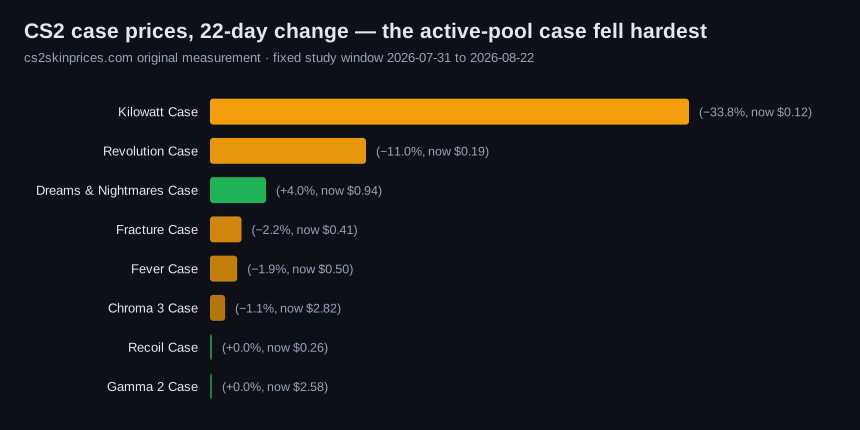
The irony of the case economy is that the container has historically been a better hold than its contents. Cases drop free to players, supply eventually stops when a case rotates out of the active pool, and demand continues indefinitely from openers — a structural supply squeeze that has pushed many retired cases from pennies to multiple dollars over several years.
In my own spreadsheet, a batch of cases I logged at under $0.60 each in mid-2023 was sitting well above $2 by early 2026 — an outcome that beat what opening those same cases would have returned by a wide margin. That is one anecdote, not a law: case prices sag when drop pools change, when player counts dip, or when a market correction hits everything at once, as spring 2025 demonstrated across the board. Our breakdown of why CS2 skin prices drop covers those mechanisms.
But the comparison that matters here is not "cases vs the stock market" — it is "holding the sealed case vs opening it." One path has historically compounded; the other reliably converts $3 into $1 of wallet credit. If you find yourself with a stack of dropped cases, checking which ones are worth keeping sealed in our guide to the best CS2 cases to open — which is candid about the fact that "best" is relative — is a better first move than reaching for keys.
The Psychology Traps the Animation Is Built On
Knowing the math is not enough, because case opening attacks the parts of your brain that do not do math. Three traps account for most of the damage.
- The near-miss effect. The reveal wheel is engineered to slow down just past a red or gold item constantly. Research on slot machines shows near-misses trigger reward circuitry almost like wins, creating a "so close, one more" pull. The wheel's stopping point was determined the moment you clicked — the drama is theater.
- Sunk cost escalation. After twenty blue drops, "I've come too far to stop now" feels logical. It is not: the odds on case twenty-one are identical to case one. Every opening is a fresh 0.26% knife lottery with no memory of your losses.
- Selective memory and survivorship bias. You remember the streamer's knife pull and your friend's Covert; you forget the thousands of invisible blue drops behind each highlight. Social feeds curate wins, so your sense of the odds drifts optimistic no matter what the published numbers say.
If you notice yourself opening to recover losses, or hiding spending from yourself, stop entirely — that pattern is gambling behavior, and no skin is worth it. This applies double for anyone under 18 with access to a parent's wallet.
A Decision Checklist, and the Bottom Line
Before any opening session, run through five questions:
- Am I fully comfortable losing 100% of this money? (Assume you will get back a fraction, as wallet credit.)
- Would I rather have the specific skin this money buys directly on the market?
- Am I opening for fun, or chasing a financial outcome the odds don't support?
- Is this money that has any other job — bills, savings, anything?
- Have I already opened cases today hoping to "win back" earlier spending?
Honest answers of yes, no, fun, no, no — go enjoy it, with a fixed budget set in advance. Any other pattern of answers means the correct number of cases to open is zero.
So, are cs2 cases worth opening? As entertainment with a firm budget: sure, and the suspense is genuinely fun. As a way to acquire skins: no — buying directly wins on price, choice, and resale every time. As an investment: emphatically no; the sealed case outperforms the opened one, and our full cases hub breaks down which containers deserve a spot in your inventory either way. The math has been public for years. The only people it doesn't work against are the ones who read it.
Frequently asked questions
What are the actual odds of getting a knife from a CS2 case?
Gold-tier items — knives or gloves — drop at 0.26%, roughly 1 in 385 openings. At $2.49 per key, the average knife costs about $958 in keys alone, before case costs. There is no pity timer and no accumulation: every opening carries the same 0.26% chance regardless of your history.
Do CS2 cases ever profit on average?
Standard openings return roughly 60–80% of their cost in expected item value, so on average, no. Brief exceptions have appeared in the first days of a new case release, when thin market supply inflates new-item prices, but those windows close fast and the returns arrive as Steam wallet credit rather than cash.
Is opening CS2 cases considered gambling?
It has the core mechanics of gambling — payment for a randomized outcome with monetary value — and several countries, including Belgium and the Netherlands at various points, have restricted loot boxes on exactly that basis. Whatever the legal label in your region, the psychological risks are the same, and treating it as anything other than paid chance is a mistake.
Why is the Steam Market price of my drop lower than I expected?
Two deductions stack against you. The Steam Market takes roughly 15% in fees when you sell, and the proceeds arrive as wallet funds that can only be spent on Steam, never withdrawn. So a $10 drop nets about $8.50 in credit — useful for games or other skins, but not money in any bankable sense.
Are old, discontinued cases better to open?
Usually the opposite. Discontinued cases cost more to acquire — sometimes dramatically more — which raises your cost per opening while the drop odds stay identical. Their contents are often pricier too, but rarely enough to offset the case price. Old rare cases are generally better held sealed than opened.
Should I open cases I got as free drops?
A free case still requires a $2.49 key, and the expected drop value is usually well under that. Selling the dropped case on the market, even for pocket change, is the mathematically better move — or holding it sealed if it belongs to a pool with a history of appreciating after rotation.
Does opening more cases at once improve my chances?
No. Each opening is an independent 0.26% roll for Gold, whether you open one case or one hundred in a session. Opening in bulk only guarantees that your results converge toward the negative expected value faster. The house edge does not care about volume, streaks, or timing.