CS2 Case Prices: What Cases Actually Cost, and Why the Cheap Ones Keep Getting Cheaper

Sukie · Founder & Market Tracker
Sukie has tracked the Counter-Strike skin economy since 2023, maintaining a price-history spreadsheet that covers 400+ skins and testing every major marketplace with her own inventory. She writes and updates every guide on CS2 Skin Prices herself.
Last updated: 2026-09-10
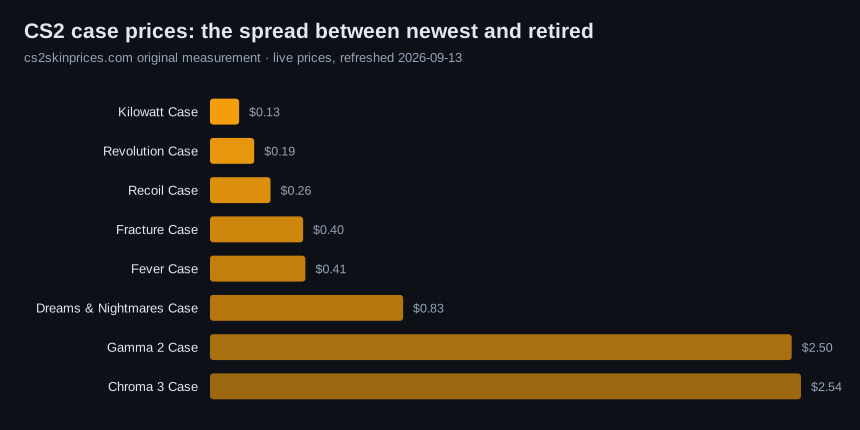
CS2 case prices span two orders of magnitude, and the gap between the cheapest and dearest case in my tracked set is not about what is inside them. At the 13 September 2026 refresh the Kilowatt Case listed at $0.13 while the Chroma 3 Case listed at $2.54 — a 20.32× spread between two containers that both drop weapon skins and both need the same $2.50 key. The entire difference is supply status: one still drops to players every week, the other stopped years ago.
That single mechanism explains almost every case price you will ever see, including the direction they move. It also explains the most expensive mistake in this corner of the market, which is buying cases as an investment during the window when they are still being printed. Below are the live numbers, the arithmetic of opening one, and what my own tracking recorded when case prices fell off a shelf in August 2026.
The live price ladder, and what each rung means
Eight cases from my tracked set, lowest live listing on the same refresh:
| Case | Price | Drop status | 22-day change |
|---|---|---|---|
| Kilowatt Case | $0.13 | Active drop pool | −33.8% |
| Revolution Case | $0.19 | Recently rotated out | −11.0% |
| Recoil Case | $0.26 | Rotated out | 0.0% |
| Fracture Case | $0.40 | Rotated out | −2.2% |
| Fever Case | $0.41 | Rotated out | −1.9% |
| Dreams & Nightmares Case | $0.83 | Rotated out | +4.0% |
| Gamma 2 Case | $2.50 | Discontinued | 0.0% |
| Chroma 3 Case | $2.54 | Discontinued | −1.1% |
Read the two end columns together and the pattern is unmistakable. The case still being printed lost a third of its value in three weeks. The two discontinued cases were flat. The middle of the table drifted.
The mechanism is simple supply. While a case is in the active drop pool, millions of copies enter circulation every week for free, handed to players as weekly drops. Nothing about demand changes; the float of available copies just keeps growing, and the listing floor slides. The moment a case rotates out, that faucet closes and the population becomes finite — and every case opened from then on permanently removes one from the world.
Which is why the arrow eventually turns around. Discontinued cases are the only containers in CS2 with a supply curve that only ever shrinks.
What opening a case actually costs
The case price is the small half of the bill. Every container requires a key, and keys are sold by Valve at a fixed price — currently $2.50 — with no discounts, no bundles and no third-party resale since the 2019 trade lock on keys.
| Kilowatt Case | Chroma 3 Case | |
|---|---|---|
| Case | $0.13 | $2.54 |
| Key | $2.50 | $2.50 |
| Total per open | case + $2.50 | case + $2.50 |
| Case as share of cost | a few percent | roughly half |
On a cheap active-pool case the key is the overwhelming majority of what you spend — often 95% or more. This has a consequence people consistently miss: hunting for a cheaper case barely changes your cost per open. Saving five cents on a case that needs a $2.50 key moves your total by about two percent. The case price only becomes a meaningful lever on the expensive, discontinued end — where, unfortunately, the expected value of opening is usually worse, because you are paying a collector premium for the container itself.
Key pricing is set by Valve and documented in Steam Support's guidance on Counter-Strike items; keys have not been tradeable or marketable since the October 2019 change, so no legitimate discount route exists.
The full expected-value arithmetic, including the roughly 0.26% knife rate and what the other rarity tiers are actually worth, is on our CS2 case opening odds page. The short version, covered honestly on are CS2 cases worth opening: for almost every case, the expected return on an open is well under what the open costs.
Why cheap cases keep getting cheaper — and the trap that follows
The Kilowatt Case falling 33.8% in 22 days is not an anomaly; it is what an active drop pool looks like on a chart. And it sets up the most common case-investing mistake I see.
The reasoning goes: this case is only nine cents, cases go up when they retire, therefore buying a thousand of them is free money. Three problems.
The bottom is not where you think. An active case has no floor while the faucet is open, and Valve does not announce rotation schedules. "It cannot go much lower than nine cents" is a statement about your intuition, not about supply.
The retirement bump is slow and modest for common cases. The cases that appreciate meaningfully are those that also happen to contain a skin the market wants years later. A retired case full of forgettable skins retires into obscurity, not into value.
Percentages are the wrong unit down here. The Recoil Case in my data finished exactly flat while swinging across a 141% range. At sub-dollar prices a two-cent listing difference is a double-digit move, so any percentage-based reasoning about cheap cases is mostly noise. Use absolute cents.
None of that means case holding never works. It means the strategy that works is patient, targeted at cases already out of the drop pool, and sized so that a 30% drawdown is survivable. Our best CS2 cases to open page ranks the current containers by what is actually in them, and why CS2 skin prices drop covers the market-wide forces that hit cases hardest.
The August 2026 case slide, and what it tells you about the wider market
Cases did not fall in isolation. Across the same 31 July to 22 August window I tracked 56 items in total — skins, knives, gloves and cases — and 47 of them fell, with a median change of −5.6%. What separates the case tier is the size of the moves rather than the direction.
Rank my whole tracked basket by 22-day decline and two of the four worst performers are cases: Kilowatt at −33.8% and Revolution at −11.0%. Meanwhile the four-figure items barely registered the same period — the AWP Dragon Lore in Factory New fell 2.3%, and in Minimal Wear it actually rose 0.3%. Same market, same three weeks, wildly different amplitude.
The reason is order-book depth. A Dragon Lore has few buyers, but the ones who exist place standing bids that catch a falling listing floor. A nine-cent case has thousands of buyers and essentially no standing bids, because nobody sets a limit order on a nine-cent item. When supply outruns demand there is nothing underneath, and the floor slides freely until it finds a seller who will not go lower.
The practical lesson for anyone holding case inventory: your position is the most volatile thing in the skin market by percentage, and the least cushioned. That is fine if you bought them to open. It is a problem if you bought them expecting a floor. The full dataset and the artefacts inside it are written up on our CS2 skin price history page.
How to buy cases without overpaying
Four rules, in order of how much money they save.
Compare venues before you buy in bulk. Case prices differ by a few cents across marketplaces, which is irrelevant on one case and material on five hundred. Steam's 15% combined fee is baked into its listing prices, and Steam balance cannot be cashed out — see our marketplace fee comparison before committing.
Never pay a premium for an active-pool case. If it still drops weekly, someone is getting it free right now and more arrive every Wednesday.
Check the trade hold. Cases bought on the Steam Market carry a trade cooldown. That does not matter if you intend to open them; it matters a great deal if you intend to move them.
Ignore the percentage, watch the cents. A case that went from $0.44 to $0.43 did not "fall 2.3%" in any meaningful sense.
One last framing, because it is the thing I most wish someone had told me early. Cases are the cheapest entertainment in CS2 and one of the worst stores of value in it, and those two facts are not in tension — they are the same fact viewed from two directions. Buy them to open for fun, on a budget you have already written off. Buy them to hold only after they leave the drop pool, only in cases whose contents you would actually want, and only with money that can sit still for years. Live prices for every case in the table above sit on our price checker, and the wider case picture is on the CS2 cases hub. If you are new to all this, start from the homepage.
Frequently asked questions
How much do CS2 cases cost?
They range from around $0.13 for a case still in the active drop pool to $2.54 for a discontinued one, based on lowest live listings at the 13 September 2026 refresh. The spread is driven almost entirely by whether the case still drops to players.
How much does it cost to open a CS2 case?
The case plus a $2.50 key. On a case listing at $0.13 the key is almost the entire cost; on one listing at $2.54 it is roughly half. Hunting for a cheaper case barely changes your cost per open.
Why are some CS2 cases so cheap?
Because they are still in the active drop pool, so millions of new copies enter circulation free every week. In my tracking the Kilowatt Case fell 33.8% in 22 days for exactly this reason, while discontinued cases were flat.
Do CS2 case prices go up after they stop dropping?
They can, because supply becomes finite and every case opened permanently removes one. But the effect is slow and much stronger for cases containing skins people still want. A retired case full of forgettable skins does not appreciate meaningfully.
Are CS2 keys ever cheaper than $2.50?
No. Valve sells keys at a fixed price with no discounts, and keys have not been tradeable or resellable since the 2019 change. Any offer of a cheaper key is a scam.
Which CS2 case is the most expensive?
Among the cases I track, Chroma 3 at $2.54 and Gamma 2 at $2.50 sit at the top. The genuinely expensive containers are older discontinued cases with sought-after contents, which trade well above these levels.
Is buying cheap CS2 cases in bulk a good investment?
Rarely, and never while the case is still dropping. An active-pool case has no floor because supply keeps growing, and Valve does not announce rotation schedules. Any bulk position should be in cases already out of the pool and sized so a 30% drawdown is survivable.
Why did my case price chart show a huge swing on a cheap case?
Because percentages are the wrong unit below a dollar. The Recoil Case finished my 22-day window exactly flat while showing a 141% range — a two-cent listing difference is a double-digit percentage move at that price.
Should I buy the case or the skin?
If you want a specific skin, buy the skin. Expected return on opening is below the cost of opening for almost every case, so buying the container is a more expensive route to the same item plus a small chance of a better one.
Do case prices differ between marketplaces?
Yes, usually by a few cents. That is irrelevant on a single case and material on a bulk purchase. Steam's 15% combined fee is reflected in its listing prices, and Steam balance cannot be withdrawn as cash.