Well Worn vs Field Tested: Which CS2 Wear Should You Actually Buy?

Sukie · Founder & Market Tracker
Sukie has tracked the Counter-Strike skin economy since 2023, maintaining a price-history spreadsheet that covers 400+ skins and testing every major marketplace with her own inventory. She writes and updates every guide on CS2 Skin Prices herself.
Last updated: 2026-08-03
Well worn vs field tested comes down to a single number: 0.38. A skin with a float value of 0.3799 wears the Field-Tested label; a skin at 0.3800 is stamped Well-Worn. The paint on those two skins is, for practical purposes, identical — you could stare at side-by-side screenshots for a minute and not tell them apart. Yet the market treats them like different products, and the Well-Worn copy routinely sells for noticeably less. That gap between what the label says and what your eyes see is one of the most reliable value pockets in the entire CS2 float system, and it is also one of the easiest places for a new buyer to get burned.
This guide covers both sides honestly. There are skins where Well-Worn is the quiet smart buy — same look, real discount. There are also skins where Well-Worn is genuinely rough, with scratches and grime that no amount of savings makes worth it. I keep a spreadsheet tracking 400+ skins across wear tiers, and the pattern that emerges is that the answer is never "WW good" or "WW bad" — it is always skin by skin, and float by float within the tier.
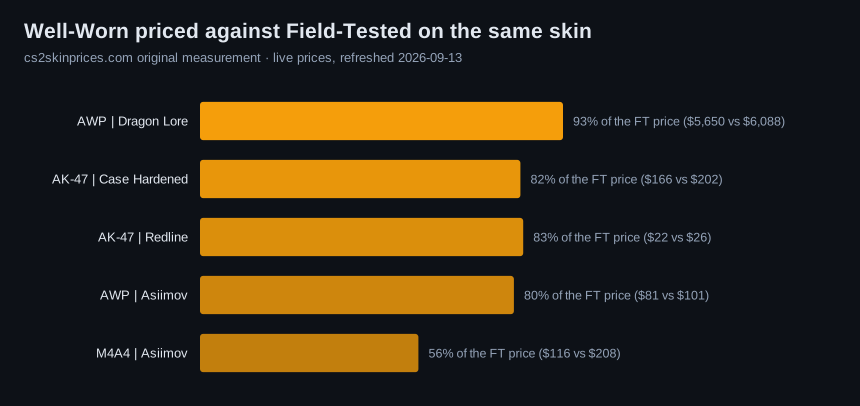
The 0.38 Boundary: One Ten-Thousandth of a Float, One Big Label Change
CS2 assigns every skin a float value between 0 and 1 at the moment it is created, and that number never changes afterward. The five wear labels are just buckets laid over that number: Factory New runs 0.00–0.07, Minimal Wear 0.07–0.15, Field-Tested 0.15–0.38, Well-Worn 0.38–0.45, and Battle-Scarred 0.45–1.00. The full breakdown lives on our CS2 float chart, but the boundary that matters here is 0.38.
Two things make this boundary strange. First, Well-Worn is the narrowest wear bucket in the game — just 0.07 of float range, compared to Field-Tested's 0.23. Second, wear in CS2 is not linear. Most skins accumulate the bulk of their visible scratching between roughly 0.07 and 0.30, then the change flattens out. By the time a skin reaches 0.35, most of the damage it is ever going to show is already there. Crossing from 0.379 to 0.381 changes the sticker on the box, not the paint on the gun.
| Well-Worn | Field-Tested | |
|---|---|---|
| Float range | 0.38–0.45 | 0.15–0.38 |
| Typical discount | Often roughly 15–40% below the same skin in FT, varying widely by skin | Baseline for most trading; usually the most-listed wear |
| Visual difference | Near-identical to a 0.35+ FT copy on most skins; noticeably rougher on light-bodied or gloss-finish skins | Ranges enormously — a 0.16 FT can look close to Minimal Wear, a 0.37 FT looks like WW |
| When it wins | Dark or busy patterns where wear hides, tight budgets, play skins you will not resell soon | When you can snipe a low-float copy near 0.15, or when resale speed matters |
Why the Price Cliff Exists (Hint: It Is Not About Looks)
If the paint barely changes at 0.38, why does the price drop off a cliff? Three reasons, none of them visual.
The label is the product for most buyers. The majority of people browsing the Steam Community Market filter by wear name and never open the inspect view. "Well-Worn" simply sounds bad — it is the only wear name that is an insult in plain English — so demand thins out the moment the label flips, regardless of what the skin looks like.
Field-Tested is the liquidity anchor. FT is usually the most-listed and most-purchased wear tier for mid-priced skins, which means tighter spreads and faster sales. Buyers default to it; sellers price against it. WW sits outside that default flow.
Trade-up and collector demand skips WW. Trade-up contract players target specific float outputs, and float-obsessed collectors chase the extremes — very low floats or true 0.9+ Battle-Scarred oddities. The 0.38–0.45 band is nobody's trophy, so a whole class of demand just isn't there.
The result is a discount that reflects psychology and market structure rather than condition. That is precisely what makes it exploitable — and precisely why you should understand it before assuming the discount is free money.
Skins Where Well-Worn Is the Smart Buy
The best WW candidates share one trait: their wear pattern plateaus early, so a 0.39 copy looks essentially the same as a 0.33 copy that costs meaningfully more. In my experience comparing inspect screenshots, three groups stand out.
- Skins with no clean wears at all. The AWP Asiimov famously cannot exist in Factory New or Minimal Wear — its float starts at 0.18 — so the community already judges it by pattern and scuff placement rather than by label. A good-looking WW Asiimov carries far less stigma than WW does elsewhere.
- Dark, matte, or busy patterns. Camo-style and dark hydrographic finishes hide scratches the way dark carpet hides stains. On these, the difference between a 0.36 and a 0.40 is close to invisible at gameplay distance.
- Skins where wear shows as subtle dulling, not scratching. Some finishes lose saturation gradually instead of accumulating white scratch marks. Dulling is smooth and gradual; there is no visual "cliff" to match the price cliff.
In March 2026 I ran a small experiment for my spreadsheet: I pulled Steam Market lows for 24 popular skins in both FT and WW on the same evening. On roughly a third of them, the WW copy was 25% or more cheaper while my own side-by-side inspects showed differences I would honestly not notice in a match. That third is where well worn vs field tested stops being a debate and becomes a discount.
Skins Where Well-Worn Is Genuinely Ugly
Now the other side, because pretending WW is always a bargain would be dishonest. Some finishes age terribly, and on these the FT premium is worth every cent.
- Dark bodies that scratch white. The AK-47 Redline is the classic case: its matte black base shows every scratch as a bright white line, and by the WW range the whole body looks like it lost a fight with a belt sander. High-float Redlines are the textbook example of a skin people regret buying on price alone.
- White and light-colored bases. Finishes with large white panels tend to pick up a gray, grimy cast as float climbs. What reads as "clean sci-fi" in Minimal Wear reads as "dropped in a parking lot" by 0.40.
- Glossy metallic and fade-style finishes. Anodized and chrome-look coatings lose their shine dramatically with wear. The entire appeal is the luster, so wear attacks exactly the thing you are paying for.
The pattern to internalize: wear damage is only acceptable when it does not collide with the skin's selling point. A camo skin's selling point survives scratches; a mirror-finish skin's selling point does not. Before buying any WW copy, inspect the actual item in-game or check its float and screenshots — our guide on how to check CS2 float walks through doing this in under a minute.
The 0.38–0.40 Hunting Tactic, and the Resale Catch
Here is the tactic that falls out of everything above: hunt for WW copies with floats between 0.38 and 0.40. These are skins that missed the Field-Tested label by a rounding error. They are visually interchangeable with the high-float FT copies selling one tier up, but they are priced against the WW pool, which is anchored by its ugliest 0.44 members. You are buying FT paint at a WW price.
The workflow is simple: filter listings to Well-Worn, sort or scan for the lowest floats in the bucket, and inspect before buying. Marketplaces with float-value filters make this trivial; on venues without filters it takes patience. The premium a 0.381 commands over a 0.449 within the same WW listing pool is usually small — the label compresses them together — which is exactly the inefficiency you are harvesting.
Now the catch, and it matters: liquidity cuts both ways. The same thin demand that made your WW copy cheap will make it slower to sell. In my own selling logs, comparable FT items consistently found buyers in days while WW copies of the same skins sat for weeks or needed an extra price cut to move. If you are buying a skin to use and hold, the WW discount is real savings. If you flip inventory frequently, the discount partly just prepays your future exit cost. Budget-conscious buyers weighing well worn vs field tested for a first loadout should also read our CS2 skin prices homepage primer on how wear interacts with price across the whole market before committing.
Frequently asked questions
Is 0.38 float Well-Worn or Field-Tested?
A float of exactly 0.38 falls at the start of the Well-Worn bucket, which runs 0.38 to 0.45. Field-Tested covers 0.15 up to but not including 0.38. In practice you will almost never see a float landing exactly on the boundary — you will see 0.379x copies labeled FT and 0.380x copies labeled WW that look identical.
Does Well-Worn always look worse than Field-Tested?
No. A 0.38 Well-Worn skin and a 0.37 Field-Tested skin are visually indistinguishable on nearly every finish. What is true is that the average WW copy looks worse than the average FT copy, because the FT bucket includes clean 0.16 floats. Always compare specific floats, not labels.
How much cheaper is Well-Worn than Field-Tested?
It varies enormously by skin, but discounts of roughly 15–40% below the same skin in FT are common, based on my own price tracking. Skins that age gracefully sit at the small end of that range; skins that scratch badly can show even larger gaps because nobody wants the WW copy at any price close to FT.
Why is the Well-Worn float range so small?
Valve defined Well-Worn as just 0.38–0.45 — a 0.07 window, the narrowest of the five wear tiers alongside Factory New. The practical effect is that WW is also one of the rarest labels to see drop, since only 7% of the float spectrum maps to it and many skins have float caps that limit the range further.
What is low-float WW hunting?
It means deliberately searching the Well-Worn listings for copies with floats between about 0.38 and 0.40. These skins look like high-float Field-Tested copies but are priced against the cheaper WW pool. You inspect before buying to confirm the look, then pay the WW price for what is effectively FT-grade paint.
Are Well-Worn skins harder to resell?
Generally yes. Fewer buyers filter for WW, so listings sit longer and often need sharper pricing to move. In my selling experience, FT copies of the same skin sold in days while WW equivalents took weeks. Factor that friction in if you plan to flip rather than keep the skin.
Can a Well-Worn skin be used in trade-up contracts?
Yes — trade-up contracts accept any wear, and the output float is calculated from the average float of your inputs mapped onto the output skin's float range. High-float WW inputs push the output toward its own high-float end, which usually lowers its value, so cheap WW inputs are not automatically good trade-up inputs.
Should a first-time buyer choose WW or FT?
For a first skin, Field-Tested is the safer default: easier to resell, bigger selection, and less risk of an ugly surprise. Choose Well-Worn only when you have inspected the exact copy and confirmed you like how it looks. The discount is real, but only when your eyes — not the label — make the call.