Field Tested CS2 Skins: Why the Middle Wear Tier Wins on Value

Sukie · Founder & Market Tracker
Sukie has tracked the Counter-Strike skin economy since 2023, maintaining a price-history spreadsheet that covers 400+ skins and testing every major marketplace with her own inventory. She writes and updates every guide on CS2 Skin Prices herself.
Last updated: 2026-07-31
It's 11 p.m. and you're hovering over two AWP Asiimov listings priced within a dollar of each other. Both tooltips say the same thing: Field-Tested. But one is a 0.16 float with crisp white body panels, and the other is a 0.36 whose scope housing has gone grey and grimy — and nothing on either price tag warns you which is which. That gap is the entire game in field tested CS2 buying: one label stretched across the widest, messiest, most rewarding band in the whole wear system, where careless buyers overpay for scuffed copies and patient ones quietly walk off with near-Minimal-Wear skins at volume-tier prices. This guide is about being the second kind of buyer.
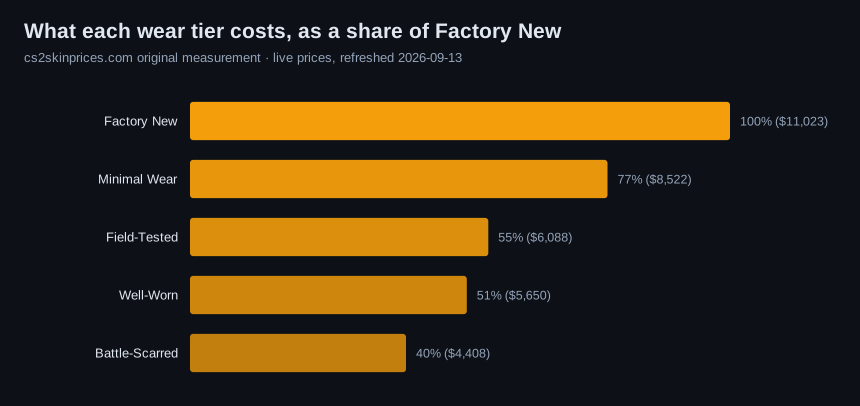
The 0.15–0.38 Float Range: One Label, Two Different Skins
Field-Tested covers floats from 0.15 to 0.38 — a 0.23-wide slice of the wear scale. Compare that to Minimal Wear's 0.08-wide band or Factory New's 0.07, and the core problem becomes obvious: FT is roughly three times wider than either tier above it, so two "identical" FT listings can look wildly different on the actual gun model. A 0.16 copy borders Minimal Wear territory; a 0.37 copy is one bad roll away from Well-Worn. The label treats them as equals. The market mostly prices them as equals, too — and that mispricing is where all the opportunity in this tier lives.
Float itself is a permanent decimal rolled at unboxing — it never changes with play, and BLAST's wear-level explainer covers the mechanics well if you're new to the concept. What matters here is the consequence: within Field-Tested, the decimal is the product, not the label. Our float value hub covers every tier's band; the rest of this page is about extracting value from this one.
Why Field-Tested Is the Value Sweet Spot
Field-Tested is where CS2's supply piles up. Unboxing rolls cluster in the low-middle of the float scale, so FT accumulates more listings than every other tier combined on many popular skins — and deep supply means competitive prices, tight spreads, and painless liquidity. In a market that SteamAnalyst's 2026 market report sizes at roughly $6.7–8 billion, the FT band is the layer where most of that money actually changes hands. Here's how FT prices sat against neighboring tiers for five heavily traded skins in my spreadsheet, as of mid-2026 (all figures approximate):
| Skin | Minimal Wear | Field-Tested | Well-Worn | Verdict in FT |
|---|---|---|---|---|
| AK-47 Redline | Around $80 | Around $40 | Around $30 | The classic budget pick — half the MW price |
| AWP Asiimov | Doesn't exist (0.18 floor) | Around $110 | Around $95 | FT is the ceiling tier; buy low float |
| M4A4 Asiimov | Around $160 | Around $85 | Around $70 | Big savings, but whites grey out — stay under 0.25 |
| Glock-18 Water Elemental | Around $9 | Around $5 | Around $4 | Dark art hides wear; FT is nearly free value |
| USP-S Cortex | Around $8 | Around $4.50 | Around $3 | Pale body shows scratches — a case for paying up |
The Redline row is the tier's whole thesis in one line: same dark base, same red stripes, half the money. In January 2026 I logged about 40 AWP Asiimov FT listings across one weekend and found sub-0.20 copies selling for barely 8% above the tier's average price — pennies for what is functionally the cleanest Asiimov that can exist.
Low-Float FT Hunting: 0.15–0.18 Is the Budget Minimal Wear
The best trade in the wear system hides at the top of this band. Copies between 0.15 and 0.18 sit millimeters over the Minimal Wear boundary; on most finishes they are visually indistinguishable from a mid-range MW copy in actual gameplay. Yet because the tooltip says Field-Tested, they're priced against FT comps — typically 5–15% above the tier average, versus the 40–100% jump to genuine MW on skins with squeezed clean-tier supply.
Hunting them is mechanical, not lucky. Community marketplaces like CSFloat, Skinport, and Buff expose float filters, so you can cap your search at 0.18 and browse only the cream of the band; the Steam Market makes you inspect listings individually, which — annoyingly — is exactly why border-float bargains linger there longer. Whichever venue you use, verify the decimal before paying: our guide on how to check CS2 float walks through the in-game inspect method step by step. One caveat: on skins where FT is the best available tier, like the AWP Asiimov and its 0.18 floor, everyone is fishing the same pool, so the low-float premium runs hotter — closer to 10–20% than 5.
Two more habits sharpen the hunt. First, browse at off-peak hours: border-float copies posted during the evening rush get grabbed within minutes, while listings that go up overnight often sit until morning at the same ask. Second, learn each finish's wear breakpoints — many CS2 textures change in visible steps rather than smoothly, so a 0.17 and a 0.21 can look identical on one skin and obviously different on another. Ten minutes of side-by-side inspecting on any skin you plan to buy repeatedly teaches you exactly which decimal is worth stretching for, and which upgrade is imaginary.
Skins That Look Great in Field-Tested
Some finishes were practically designed to be bought in FT — and the best field tested CS2 buys all share the same three traits: a dark or matte base color, busy artwork that camouflages scuffs, and wear zones that fall away from the skin's focal point. Standouts I'd happily run at 0.30+ float:
- AK-47 Redline — the black rubberized base barely registers wear; only the red stripes dull slightly.
- AK-47 Slate — near-monochrome dark finish; FT and MW are effectively twins in-game.
- Glock-18 Water Elemental — saturated orange-and-teal art keeps reading clean deep into the band.
- AWP Asiimov — no choice, but a happy accident: the design stays iconic even as floats climb, and some players deliberately chase darker high-float looks.
- M4A1-S Night Terror and similar dark-canvas finishes — the wear texture blends into the artwork instead of fighting it.
For a full comparison of how these tiers ladder up in price across the market, our pillar guide on Factory New vs Minimal Wear vs Field-Tested runs the same-skin math tier by tier.
Skins to Skip in Field-Tested
The tier punishes bright, pale, and reflective finishes. White panels collect grey scuffing at pattern edges, mirror effects turn cloudy, and the "worn" texture that vanishes on a Redline sits front and center on a light canvas. The M4A4 Asiimov's white body is the textbook case — gorgeous under 0.20, visibly tired by 0.30. The USP-S Cortex shows peppered scratches across its pale receiver by the mid-band. Printstream-family skins arguably lose the very thing you're paying for, that showroom pearl-and-chrome cleanliness, the moment floats climb past the low 0.20s.
For these finishes, one of two moves beats a mid-float FT buy: either hunt the 0.15–0.18 window hard and accept the small premium, or pay up for the genuine clean tier — our Minimal Wear guide covers when that step is worth it. The worst outcome is the lazy middle: paying an average FT price for a 0.33 copy of a white skin, then noticing the grime every single round. Wear you see constantly is the most expensive kind, whatever the tooltip says.
Reselling Field-Tested: What Happens When You Cash Out
FT's deep supply cuts both ways: you'll never struggle to sell, but you'll never command a scarcity premium either. Popular FT skins are the market's most liquid items — competitively priced listings on high-volume skins typically move within hours, versus days or weeks for four-figure Factory New showpieces. Spreads stay tight, so the price you see is close to the price you'll get. Remember the house cut, though: the Steam Market takes roughly 15% of every sale, which instantly erases a thin flip margin. Low-float copies recover some pricing power at resale, but only if you list them where floats are visible and filterable — a 0.157 buried in Steam's default listing view earns nothing extra.
Price behavior between the extremes is steady: FT tracks the overall market's direction with less violence than FN tiers in both booms and sell-offs, which makes it a forgiving place to park a budget inventory. If you're planning an exit, our walkthrough on how to sell CS2 skins covers fees and venue tradeoffs, and you can watch tier-level price movement across skins on CS2 Skin Prices before timing your listing.
Timing beats tier-picking at the exit, too. Demand for mid-priced FT rifles swells around Majors and fresh case releases, when returning players restock loadouts, and thins out in the quiet weeks after a hype cycle deflates. Selling into the swell rather than the lull routinely moves the realized price by more than any low-float premium will — a patient week of waiting is often worth more than a month of float hunting was.
Frequently asked questions
What float range is Field-Tested in CS2?
Field-Tested covers floats from 0.15 to 0.38. It's the widest of the three heavily traded tiers — nearly three times the span of Minimal Wear — which is why two FT copies of the same skin can look so different in-game.
Does field tested cs2 mean someone actually used the skin in matches?
No. The wear is purely cosmetic and assigned by a random float roll the moment the item is unboxed. A Field-Tested skin straight out of a case has never been fired. Playing with a skin never changes its wear.
Is Field-Tested better value than Minimal Wear?
Usually, yes — especially on dark or busy finishes where the tiers look nearly identical in gameplay. On the AK-47 Redline, FT runs about half the MW price for a visually similar gun. Bright, white-heavy skins are the main exception where MW earns its premium.
Can a Field-Tested skin look like Minimal Wear?
Yes. Copies in the 0.15–0.18 window sit just over the MW boundary and are visually near-identical to mid-range MW on most finishes. They typically cost only 5–15% above the FT average, which makes them the best value pocket in the wear system.
Why is the Field-Tested band so much wider than the others?
Valve's tier boundaries aren't evenly spaced — FT alone covers 23% of the float scale while FN and MW cover about 7–8% each. Combined with unboxing rolls clustering in the low-middle of the scale, that's why FT holds the most supply and the most listings.
Do stickers look worse on Field-Tested skins?
Stickers keep their own condition regardless of the gun's float, but the canvas around them matters. A crisp holo on a scuffed 0.35 body can look mismatched, which is why serious sticker crafters usually start from Minimal Wear or better.
Are Field-Tested knives worth buying?
Often, yes. Dark knife finishes hide wear as well as dark rifles do, and the FT discount on knives is frequently hundreds of dollars. Check each knife's float cap first, though — many finishes have restricted ranges, so an FT label can mean different decimals on different knives.
How much cheaper is Field-Tested than Minimal Wear usually?
It varies enormously by skin — roughly 20% to 50% cheaper is common, and squeezed cases like the Redline reach 50%+. The gap depends on the skin's float floor, how visible its wear is, and how thin the MW supply band happens to be.
Do Field-Tested skins hold their value?
As well as the underlying skin does. FT is the most liquid tier, so its prices track the broader market closely with relatively little tier-specific drama. You won't catch scarcity-driven spikes like rare FN copies sometimes do, but you also avoid their sharper drawdowns.