Factory New Minimal Wear Field Tested: CS2's Three Main Wear Tiers Compared

Sukie · Founder & Market Tracker
Sukie has tracked the Counter-Strike skin economy since 2023, maintaining a price-history spreadsheet that covers 400+ skins and testing every major marketplace with her own inventory. She writes and updates every guide on CS2 Skin Prices herself.
Last updated: 2026-07-31
Factory new minimal wear field tested — those three labels shape a CS2 skin's price more than the artwork itself does. Two copies of the same AK-47 finish, identical in every way that affects gameplay, can sit $40 apart on the Steam Market purely because one tooltip reads Factory New and the other reads Field-Tested. The label comes from a hidden decimal called float, and once you understand how the three main tiers map to that decimal, most of the "confusing" price gaps you see while browsing start making complete sense.
These three tiers matter more than the other two (Well-Worn and Battle-Scarred) because they carry the overwhelming majority of trading volume. Open any popular rifle skin's listings and you'll typically find hundreds of Field-Tested copies, a healthy stack of Minimal Wear, a thin premium shelf of Factory New — and comparatively quiet activity below them. If you learn to price just these three tiers well, you can navigate almost the entire market.
This guide walks the full ladder: what each tier actually means, the exact float boundaries, where wear physically appears on the gun model, and — most importantly for your wallet — how prices step down from tier to tier and when each step is worth paying. I keep a spreadsheet tracking wear-tier prices across more than 400 skins, so the numbers below come from listings I've logged myself rather than guesses.
One warning before we start: tier logic is skin-specific. A rule that saves you money on an AK-47 Redline will cost you money on an AWP Asiimov, because those two skins don't even offer the same tiers. Everything below is built around that idea — general principles first, then the named exceptions that trip buyers up.
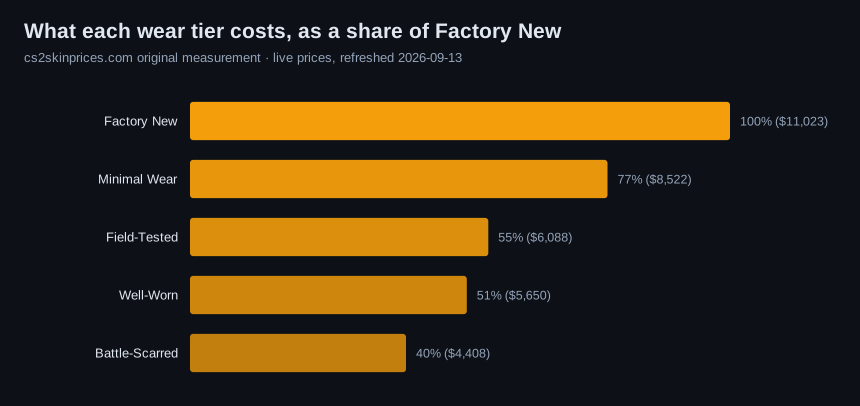
What the Three Tiers Actually Tell You
Every CS2 skin carries an "Exterior" label — one of five wear tiers — that summarizes its float value, a decimal between 0.00 and 1.00 rolled the instant the item is created. Lower float means less painted-on wear. The label is a shorthand: instead of asking buyers to interpret "0.23," Valve buckets floats into named ranges. When people compare factory new minimal wear field tested listings, what they're really asking is how much visual cleanliness each step up the ladder buys, and how much of the price gap is cosmetics versus pure scarcity.
Here is how the five tiers divide the float scale, and the role each one plays in day-to-day trading. Notice how lopsided the slices are — that asymmetry drives almost everything about supply.
| Tier | Float range | Slice of the 0–1 scale | Typical market role |
|---|---|---|---|
| Factory New (FN) | 0.00 – 0.07 | 7% | Showcase tier; thinnest supply, largest premiums |
| Minimal Wear (MW) | 0.07 – 0.15 | 8% | Near-new looks at a discount; the compromise tier |
| Field-Tested (FT) | 0.15 – 0.38 | 23% | Volume king; the most listings and most stable prices |
| Well-Worn (WW) | 0.38 – 0.45 | 7% | Thin, awkward band; often barely cheaper than FT |
| Battle-Scarred (BS) | 0.45 – 1.00 | 55% | Bargain bin, with occasional collector niches |
Because unboxing rolls cluster toward the lower-middle of the scale, Field-Tested ends up as the natural home of most drops, while true Factory New copies stay scarce. Our float value hub digs into the decimal itself; this page focuses on how the three big labels translate into dollars.
The Exact Float Boundaries — and Why the Edges Matter
The boundaries are hard cutoffs, not gradients. A skin at 0.0699 is Factory New; at 0.0701 it's Minimal Wear, forever. Float is fixed at the moment of unboxing or trade-up and never changes afterward — no amount of matches, inspects, or trades wears a skin down. BLAST's explainer on float value and wear levels is a solid neutral reference if you want the mechanics from a second source.
The complication: many skins don't span the full 0.00–1.00 scale. Each finish has its own float cap and floor set by Valve, and the five tier labels still apply inside that window. Three examples worth memorizing:
- AK-47 Redline has a floor of 0.10, so Factory New Redlines simply don't exist, and its Minimal Wear band is squeezed into 0.10–0.15.
- AWP Asiimov has a floor of 0.18 — no FN, no MW. Field-Tested is the cleanest Asiimov you can ever own, which quietly changes the value math for the entire skin.
- Doppler knives cap at 0.08, so essentially every copy is Factory New or clean Minimal Wear.
Before assuming a tier exists for the skin you want, check its specific range on our CS2 float chart. Chasing a Factory New version of a skin that can't roll one is a surprisingly common beginner mistake — and sellers occasionally exploit that confusion.
Where Wear Actually Shows on the Gun
Wear in CS2 isn't a uniform dirt layer. The paint erodes first at pattern edges and high-contact geometry: the barrel tip, magazine edges, the top of the receiver, stock corners. That means the visual difference between tiers depends heavily on what the skin looks like in those zones.
High-contrast and light-colored finishes suffer most. The white panels on an M4A4 Asiimov turn grey and scuffed as float climbs; a USP-S Cortex shows peppered scratches across its pale body by the mid-0.20s; anything in the Printstream family loses its mirror-clean look fast. Dark, matte finishes hide wear brilliantly — an AK-47 Slate or Redline at 0.30 float reads nearly identical to a 0.16 copy in an actual match because the black base color barely changes, and only the red accents dull slightly.
Viewing distance is the other half of the story. In first-person gameplay you see the left rear quarter of the weapon at arm's length, often while moving. Scratches that look dramatic in the inspect screen's zoom simply don't render at that distance. This is why experienced buyers talk about "inspect-screen wear" versus "in-game wear" — and why paying a large premium to fix wear you'll never actually see is the most common way budget players waste money on skins.
How Prices Step Down From Tier to Tier
Tier pricing runs on two engines: visual delta (how much better does the next tier actually look?) and scarcity (how many copies exist in that band?). When both engines pull together — a bright skin with few clean drops — the FN premium gets enormous. When both are weak — a dark skin with plentiful supply — tiers compress until MW costs barely 15% more than FT. There is no universal multiplier, which is exactly why per-skin comparison matters. Here's the same-skin ladder for two of the most traded rifles, from my price log, with rough Steam Community Market figures as of mid-2026:
| Wear tier | AK-47 Redline | AWP Asiimov |
|---|---|---|
| Factory New | Doesn't exist (0.10 floor) | Doesn't exist (0.18 floor) |
| Minimal Wear | Around $80 | Doesn't exist (0.18 floor) |
| Field-Tested | Around $40 | Around $110 |
| Well-Worn | Around $30 | Around $95 |
| Battle-Scarred | Around $22 | Around $80 |
Read the two columns side by side and the logic jumps out. Redline FT sells for roughly half its MW price — a huge step — because MW Redlines are squeezed into a tiny 0.10–0.15 window and stay scarce. Asiimov's ladder is flat by comparison: with FT as its ceiling tier, there's no cleaner version pulling prices upward, so WW trails FT by only 15% or so. In May 2025, when the whole market pulled back by double digits inside two weeks, I watched Redline FT dip about $6 while the MW copies barely moved — thin premium bands often ride out sell-offs better than the volume tier does.
My one-line buying rule: pay for the wear you can see at arm's length in a match — not the wear the tooltip brags about.
When Field-Tested Is the Smart Buy
Field-Tested is the right call more often than its reputation suggests. Buy FT when the skin's base is dark or busy (Redline, Slate, most camo-style finishes), when the skin's float floor makes FT the best available tier anyway (Asiimov), or when you're stretching a fixed budget across a whole loadout rather than one showpiece. A $100 budget buys one Minimal Wear rifle — or a Field-Tested rifle, pistol, and knife-adjacent glove upgrade with change left over. You can browse current tier-by-tier examples across the market on CS2 Skin Prices to sanity-check any gap before paying it.
The elite version of this move is low-float FT hunting: copies in the 0.15–0.18 window carry the Field-Tested label and something close to the Field-Tested price, but look nearly Minimal Wear on the model. Sellers list them only modestly above the tier average, and they're the single best value pocket in the entire wear system. We've written a dedicated guide to the tier — see Field-Tested in CS2 — including which skins hide their wear best and which give it away.
When Minimal Wear Is Worth Paying Up
Minimal Wear earns its premium in specific situations. Bright, reflective, or white-heavy finishes — Printstream, Asiimov-style whites, chrome and pearl effects — degrade visibly through the FT band, so stepping up to MW buys a difference you'll genuinely notice in game. Sticker crafters should also default to MW or better: a clean canvas makes a $30 sticker investment look intentional instead of grimy. And if resale matters to you, MW copies of popular skins sell faster and hold their percentage value better than high-float FT copies of the same skin, because the pool of "clean copy" buyers is deep and constant.
The premium math is friendlier than most people assume. On plenty of mid-priced skins, MW runs only 10–25% above FT — a modest toll for near-new looks. The trap is paying that toll on a dark skin where the tiers are visually identical, or paying way past it on skins where FN supply is healthy and drags MW's ceiling down. Our Minimal Wear guide breaks down the sweet-spot floats and the best-value MW picks by price bracket.
Tier Traps: The Ways Labels Lie to You
Because labels bucket a continuous decimal, the edges of every band hide traps. The classic one is the high-float Minimal Wear copy: a 0.145 float wears the MW label and the MW price, but sits a hair from the FT boundary and looks like a mid-range Field-Tested skin on the model. You pay the clean-tier premium for volume-tier looks. The mirror image — 0.151 FT that looks like MW — is the bargain version of the same math, and it's the reason serious buyers filter by decimal, not by label.
A few habits neutralize every trap in this category:
- Never buy on the label alone; check the actual decimal first. Our walkthrough on how to check CS2 float covers the in-game inspect method and third-party tools.
- Know the skin's personal float window before judging a number — a "high" float on a capped skin can be its best available version.
- Inspect in-game whenever real money is involved. Screenshots flatter; the 3D model doesn't.
- Compare against the same tier only. A FT listing "cheap versus MW prices" isn't cheap, it's mislabeled marketing.
None of this requires paid tools — just thirty seconds of checking before you commit.
How StatTrak and Souvenir Change the Tier Math
StatTrak and Souvenir versions follow exactly the same float bands, but they multiply the scarcity engine. StatTrak drops are far rarer than normal ones, so the tier ladder gets steeper: a StatTrak FN copy of a popular skin can run several times its normal-FN price, while StatTrak FT often carries a much gentler markup. If you want the orange counter on a budget, StatTrak Field-Tested is usually the rational entry point — the counter looks identical at every float.
Souvenir items — dropped around Majors and stamped with event stickers — sit in their own pool with no StatTrak variant, and their tier gaps swing on event nostalgia as much as wear. A clean-float Souvenir from a beloved Major can outprice logic entirely, which is collector territory rather than value shopping. For most budget players the takeaway is simple: master the plain factory new minimal wear field tested ladder first, and treat StatTrak and Souvenir premiums as separate purchases layered on top — ones that only hold their value when the underlying skin does.
Frequently asked questions
Does a skin's wear tier ever change after I own it?
No. Float is assigned the instant an item is unboxed or created through a trade-up, and it never changes afterward. Playing thousands of matches, inspecting, trading, or storing the skin has zero effect. The Exterior label you buy is the one you keep forever.
Is factory new minimal wear field tested always the price order, high to low?
Almost always, but capped float ranges create exceptions. When a skin has no FN (like the AWP Asiimov), FT becomes the premium tier and prices compress below it. Very rarely, a Battle-Scarred niche — like the near-black 'Blackiimov' look collectors chase — can outprice Well-Worn copies of the same skin.
Why do some skins have no Factory New version?
Valve gives every finish its own minimum and maximum float. If the floor sits at 0.10, as on the AK-47 Redline, floats below that simply cannot roll, so the FN band is empty. Always check a skin's specific range before hunting a tier that may not exist.
How much more should I pay for Minimal Wear over Field-Tested?
On dark or matte skins, treat anything past a 10–25% premium as paying for a label. On bright or white-heavy finishes the visual gap is real, and 30–50% can still be fair. The honest test: inspect both tiers in-game and ask whether you'd notice the difference mid-round.
Do wear tiers affect accuracy, damage, or anything in gameplay?
No. Wear is purely cosmetic. A 0.97 Battle-Scarred rifle shoots identically to a 0.003 Factory New one. Every price difference between tiers is about looks, scarcity, and resale — never performance.