Navaja Knife CS2 Guide: Every Finish, Real Prices, and an Honest Verdict

Sukie · Founder & Market Tracker
Sukie has tracked the Counter-Strike skin economy since 2023, maintaining a price-history spreadsheet that covers 400+ skins and testing every major marketplace with her own inventory. She writes and updates every guide on CS2 Skin Prices herself.
Last updated: 2026-08-04
The Navaja Knife CS2 sells today is the cheapest way into the gold-name tier, and it has held that title almost since the day it arrived. Camo finishes start around $65-80 as of mid-2026, which means a real knife — same Special rarity as a $4,000 Karambit — costs less than a lot of single rifle skins. That is the appeal, and it is a genuine one.
It is also only half the story. The Navaja is small, its animations are modest, and plenty of people buy one, use it for a month, and quietly move on. This page runs through every finish with a hedged price, points out the two or three that are genuinely worth owning, and gives you a straight answer about who this knife is right for. I have watched the Navaja's price band closely since 2023, and my view has not changed much: it is an excellent purchase for exactly one kind of buyer and a mediocre one for everybody else.
Where the Navaja Came From and Why It Sits at the Bottom
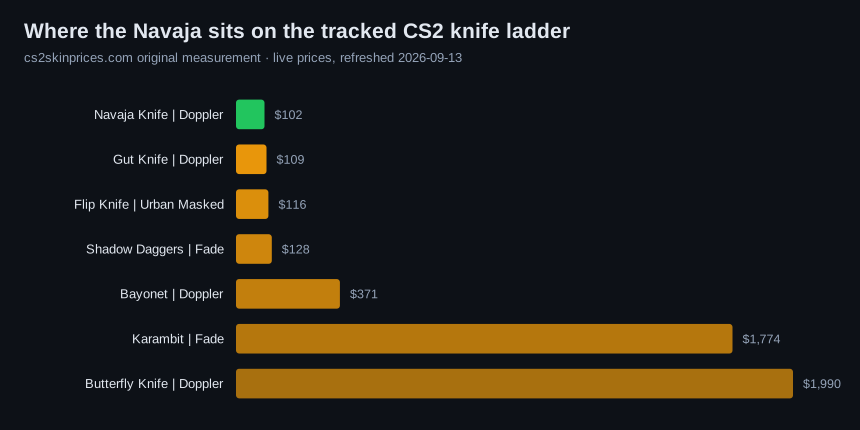
The Navaja arrived with the Horizon Case in September 2018, alongside the Stiletto, Talon, and Ursus. Of that group it was immediately the cheapest, and eight years later nothing has changed. Its floor is now the reference point the entire knife market is measured against — when people ask what the cheapest knife in CS2 is, this is usually the answer.
The reasons are not complicated. The Horizon Case was opened enormously, so supply is deep. And the model is a Spanish folding navaja: a slim, curved folding blade with a wooden-look handle that spends most of its screen time closed and tucked. It is roughly the smallest knife silhouette in the game apart from the Shadow Daggers.
Worth being precise about rarity, because it gets muddled constantly. Every knife sits in the Special tier and drops at roughly 0.26% per case — about 385 cases on average, or something like $958 in keys. The Navaja is not a lesser rarity; it is exactly as rare as a Butterfly. It is simply less wanted, and price here tracks demand, not scarcity. Sort any knife category by price on the Steam Community Market and the Navaja is what you find at the front.
The Honest Take on Size and Animations
Most Navaja Knife CS2 write-ups skip this part or bury it. It deserves to be up front, because it is the thing people regret.
In first person the closed Navaja occupies a small corner of the lower right of your screen. The draw flicks it open with a quick wrist snap, genuinely satisfying the first fifty times. The inspect opens and closes the blade with a couple of spins — brisk, tidy, over in about a second and a half. Nothing about it is clumsy. There is also not much of it.
Compare that with what the expensive knives do. The Butterfly's flip sequence runs long and shows off; the Stiletto's draw has a snap that sells the whole model; the Karambit spins on a finger. Those animations are the product. The Navaja's are functional.
The practical consequence is that finishes matter far more on this knife than on larger ones. A pattern finish spread across a Kukri or Bowie blade reads clearly. The same pattern on a folded Navaja shows a sliver. This is why my finish recommendations below skew hard toward finishes with strong, simple color rather than intricate patterns — on a blade this size, subtlety disappears.
Finish by Finish, With Hedged Prices
Every price below is approximate as of mid-2026 and comes from my own tracking spreadsheet. Knife prices drift with operations and case rotations, so treat these as bands you should verify before buying.
Premium finishes ($140 and up)
- Doppler gem phases — Ruby, Sapphire, or Black Pearl, roughly $400-1,100 in Factory New. Extremely thin supply and wide spreads; a collector purchase, not a practical one.
- Fade — around $180-230, Factory New only because the finish has a capped float range. High fade percentages carry a premium. On a Navaja this is the single most effective finish: pure color, no detail lost to blade size.
- Marble Fade — around $160-210, Factory New. Fire and Ice patterns price separately and higher. Bold enough to survive the small canvas.
- Doppler Phases 1-4 — around $150-200, Factory New. Phase 2 and Phase 4 usually sit at the top of that band. Strong color, reliably good on this model.
- Tiger Tooth — around $140-180, Factory New. No pattern lottery, consistent gold-on-black look, genuinely one of the better small-knife finishes.
Mid-tier finishes ($90-140)
- Crimson Web — around $110-260 depending on web count and placement. A high-web Navaja is beautiful; a low-web one looks like a plain red-brown knife. Check images, never the label.
- Vanilla — around $105-135. No finish at all, just bare steel. A taste purchase, and on a small folding knife it reads cleaner than you would expect.
- Slaughter — around $100-130. Marbled red, forgiving of wear, and one of the few pattern finishes that still reads at Navaja scale.
- Case Hardened — around $90-140 in Field-Tested, driven almost entirely by blue percentage. Honestly, this is the finish I would skip on a Navaja: the blade is too small to show off a good pattern, so you pay a pattern premium for something nobody will notice.
Budget finishes ($65-100)
- Damascus Steel — around $80-100 in Field-Tested. Attractive rippled steel, but it needs a low float; above 0.25 the pattern muddies.
- Blue Steel — around $78-98. Same warning, harder. Buy under 0.20 or do not buy.
- Ultraviolet — around $75-95. Flat dark purple. Cheap and inoffensive, shows scratches clearly.
- Night Stripe — around $75-92. Quietly the best-looking of the cheap tier: crisp diagonal stripes that hold up at small scale.
- Stained, Boreal Forest, Urban Masked — around $70-88 in Field-Tested. Serviceable camo, nothing more.
- Safari Mesh, Scorched, Rust Coat, Forest DDPAT — around $65-80, usually Battle-Scarred. The absolute family floor and the cheapest gold name in the game.
The Picks Actually Worth Your Money
Three of those entries are worth singling out, because the rest are either compromises or things you buy for reasons other than value.
Best under $95: Night Stripe. It costs roughly $10-15 more than the true floor and looks deliberate instead of accidental. The stripe pattern is high contrast and legible even on a closed blade, and it does not depend on float the way Blue Steel or Damascus Steel does. If somebody tells me they want a knife and have under $100, this is the one I name.
Best around $180-230: Fade. The Navaja Fade is the strongest argument the family has. Because Fade is effectively a Factory New-only finish with a capped float range, you never have to shop wear at all — you shop fade percentage and price. The result is a small knife that is unmistakably a nice item, for less than a plain camo Butterfly costs by a factor of three.
Skip unless you specifically want it: Case Hardened. Pattern finishes need surface area. On a Navaja, a top-tier blue pattern is mostly hidden, and you are paying a premium for something the blade cannot display.
One float note that saves money across all of these: on cheap camo finishes, the difference between wear tiers is smaller than the price gap suggests, so Battle-Scarred is fine. On smooth metallics, it is enormous. If you are not confident reading wear bands yet, the comparison of Factory New vs Minimal Wear vs Field-Tested is worth ten minutes before you spend anything.
Who Should Buy a Navaja, and Who Should Not
Buy one if you want a gold name in your inventory at the lowest possible cost and you are clear-eyed about what you are getting. Buy one if you like small, quick knives — some people genuinely prefer the tidy flick to a long showy flip, and that preference is not wrong. Buy one if you are assembling a coordinated loadout on a tight budget, where the knife needs to be present rather than dominant; pairing a Navaja with cheap gloves is a well-trodden route, and knife and glove combos under $100 covers how that works in practice.
Do not buy one if what you actually want is the feeling you get watching knife videos. Those knives are Butterflies and Karambits, and a Navaja will not scratch that itch — it will postpone it, expensively. Do not buy one if your gun skins are still default; the same $75 spent on weapons you look at every round changes far more of your screen, and a first skin buying guide approach gets you further. And do not buy one expecting it to appreciate. The Navaja floor has been broadly stable for years, drifting 10-15% in either direction, but stability is the whole story here — nobody has ever gotten rich on a Navaja.
The version of this purchase I endorse without hesitation: you have a loadout you like, you have wanted a knife for a while, and you would rather own a modest one now than wait a year for a Butterfly. In that case a Navaja Knife CS2 buyers pick up for $75-90 is money well spent. Browse the wider CS2 knives guide if you want to see what the next few rungs up look like, or start at the CS2 skin prices homepage for how knives fit against cases, floats, and everything else.
Frequently asked questions
How much does a Navaja Knife cost in CS2?
Camo finishes such as Safari Mesh and Rust Coat run roughly $65-80 as of mid-2026, mid-tier finishes land between $90 and $140, and premium finishes like Fade or Marble Fade sit around $160-230. Doppler gem phases go far higher. All figures are approximate bands that move with the market.
Is the Navaja the cheapest knife in the game?
Usually, though it trades places with the Shadow Daggers depending on the week. Both families float around the same $65-90 floor, with the Gut Knife just above them. If you want the outright lowest price on any given day, check all three rather than assuming one is always cheapest.
Why is the Navaja so cheap if it has the same rarity as a Karambit?
Rarity controls drop chance, not desirability. Every knife sits in the Special tier at roughly 0.26% per case, so a Navaja is exactly as rare as a Butterfly. Its price is low because the model is small and its animations are plain, and price in this market follows demand rather than scarcity.
Which Navaja finish looks best?
Fade if you can spend around $200, because pure color reads perfectly at small scale. Night Stripe at roughly $75-92 is the best cheap option, with high-contrast stripes that stay legible on a folded blade. Intricate pattern finishes like Case Hardened are the weakest fit for this model.
Does float matter on a Navaja?
It depends entirely on the finish. On busy camo patterns, Battle-Scarred looks fine and saves real money. On smooth metallic finishes like Blue Steel, Damascus Steel, or Ultraviolet, high floats look genuinely bad, so target under 0.20 or choose a different finish. Fade has a capped range and is effectively Factory New only.
Can I trade up to a Navaja Knife?
No. Trade-up contracts take ten skins of one rarity and return one skin of the next rarity up, with Covert as the ceiling. Knives live in the Special tier, which contracts cannot reach at any input. The only routes to a Navaja are opening a case or buying one outright.
Will a Navaja hold its value?
Historically the floor has been steady rather than rising, moving maybe 10-15% in either direction across a year. Because supply only grows through case openings while players keep entering and leaving the game, the bottom of the knife market has been one of the more stable price bands. That is not a guarantee of anything.