CS2 Kukri Knife: Every Finish, Real Prices, and the Case Hardened Deep Dive

Sukie · Founder & Market Tracker
Sukie has tracked the Counter-Strike skin economy since 2023, maintaining a price-history spreadsheet that covers 400+ skins and testing every major marketplace with her own inventory. She writes and updates every guide on CS2 Skin Prices herself.
Last updated: 2026-08-01
The CS2 Kukri Knife is the newest knife family in the game, added alongside the Kilowatt Case in February 2024, and it has spent every month since then behaving differently from the knives around it. It is bigger than the budget models, cheaper than the famous ones, and it carries a shape nobody else in the game has — a heavy forward-curving blade modeled on the real Nepalese kukri.
That combination has made it the most interesting price story in the knife market for two years running. When it launched, the floor sat well north of $200 as supply trickled out of a brand-new case. By mid-2026 the plain camo finishes have settled into the $95-125 range, which puts the whole family squarely in the lower-middle tier, above the Navaja and Gut Knife but comfortably below a Stiletto or a Butterfly.
This page covers what the model actually looks like in your hands, every finish with a hedged price, and a proper breakdown of the Case Hardened kukri — the finish that generates most of the search traffic and most of the confused buying. If you have been trying to work out whether the Field-Tested Case Hardened everyone lists is the smart buy or the trap, that section is the one to read.
What the Kukri Knife Is and Where It Came From
Valve shipped the Kilowatt Case on February 7, 2024, and the Kukri Knife was its headline addition — the first genuinely new knife model in years and the only one added to Counter-Strike 2 since the game replaced CS:GO. It sits in the Special rarity tier like every other knife: the same brutal 0.26% drop rate, about 385 cases on average, roughly $958 in keys before a gold name appears.
The model is a wide, heavy, forward-curving blade with a pronounced belly and a short wooden-style grip. In first person it reads as a chopping tool rather than a fighting knife, which is either the appeal or the problem depending on who you ask. It is noticeably larger on screen than a Navaja or Falchion.
Two structural facts shape its market. It comes from exactly one case, so supply tracks Kilowatt openings rather than a decade of accumulated drops — and that case is still in rotation, so new copies keep arriving. The CS2 cases hub lays out how case supply drives pricing.
The Animations: Why People Love It or Bounce Straight Off It
Knife prices are animation prices. The Butterfly costs what it costs because of the flip; the Karambit costs what it costs because of the spin. So the honest question about the kukri is what its animations do for you.
The inspect is a two-handed affair — the character rolls the blade over, catches it, and gives it a short chopping arc. It is deliberate and weighty rather than flashy, reading more like a tool being checked than a weapon being shown off. The draw is quick and unremarkable. No snap, no spin, no flourish.
People split hard on this. The camp that likes it appreciates that the kukri looks like something you would actually use, and that the wide blade gives finishes a large canvas — a Fade on a kukri shows far more color than the same finish on a Navaja. The camp that does not like it finds the animation flat and the silhouette agricultural.
My own take after two years of watching listings: the kukri sells consistently but rarely sells with enthusiasm. It is bought for blade area and price band, not for animation, and that is exactly why it costs less than knives with half its screen presence.
Every Kukri Finish With a Hedged Price
The CS2 Kukri Knife carries the standard knife finish set, from premium color-shift patterns down to workhorse camos. Prices below come from my own tracking spreadsheet and are approximate as of mid-2026 — bands, not quotes, because knife pricing moves with operations, case rotations, and general market mood.
| Finish | Wear to expect | Hedged price | Note |
|---|---|---|---|
| Doppler (Ruby / Sapphire / Black Pearl) | Factory New | ~$800-1,900 | Gem phases; thin supply, wide spreads |
| Doppler (Phase 1-4) | Factory New | ~$300-420 | Phase 2 and 4 usually priciest |
| Fade | Factory New only | ~$380-470 | Full-percentage fades carry a premium |
| Marble Fade | Factory New | ~$330-410 | Fire and Ice patterns priced separately |
| Tiger Tooth | Factory New | ~$280-350 | Consistent look, no pattern lottery |
| Crimson Web | Minimal Wear / Field-Tested | ~$180-460 | Web count and placement drive the range |
| Case Hardened | Field-Tested | ~$150-260 | Blue percentage is everything |
| Slaughter | Minimal Wear / Field-Tested | ~$175-225 | Pattern-dependent but forgiving |
| Vanilla (no finish) | Not applicable | ~$180-235 | Bare steel; a taste purchase |
| Damascus Steel | Field-Tested | ~$130-165 | Wear shows quickly on the flats |
| Blue Steel | Field-Tested | ~$120-155 | Buy low float or skip |
| Ultraviolet | Field-Tested | ~$115-145 | Flat purple-black; scratches obvious |
| Night Stripe | Field-Tested | ~$112-140 | Quietly one of the better cheap looks |
| Stained / Boreal Forest / Urban Masked | Field-Tested | ~$100-130 | Solid mid-camo territory |
| Safari Mesh / Scorched / Rust Coat / Forest DDPAT | Battle-Scarred | ~$95-122 | The family floor |
Notice how compressed the bottom is. Roughly $30 separates the cheapest kukri from a mid-camo one, so paying up for a cleaner float or a better pattern is unusually good value here — on a Butterfly the same relative step costs hundreds.
The Case Hardened Kukri, Properly Explained
Case Hardened is a pattern finish, not a uniform one. Each copy is generated from a pattern index between 1 and 1,000, and that index decides how much of the blade shows blue, how much shows the gold-brown mottling, and where each falls. Two Field-Tested copies at identical floats can look completely different and trade $80 apart.
The hierarchy collectors use: mostly-blue playsides at the top, balanced blue-and-gold in the middle, gold-dominant patterns at the bottom. Because the kukri blade is wide, blue coverage reads far more dramatically on it than on smaller models — a genuine argument for buying Case Hardened on this knife specifically.
Wear matters too, and it interacts with pattern rather than sitting alongside it. Here is how the bands break down in practice.
| Wear band (float) | Hedged price | What you are paying for | Watch out for |
|---|---|---|---|
| Factory New (0.00-0.07) | ~$300-430 | Cleanest possible blue saturation | Thin supply; low-blue FN copies are overpriced |
| Minimal Wear (0.07-0.15) | ~$215-300 | Near-FN color, better availability | Light scuffing along the spine |
| Field-Tested (0.15-0.38) | ~$150-215 | The volume tier — most listings and most trades | Identical prices hide wildly different blue percentages |
| Well-Worn (0.38-0.45) | ~$138-180 | A narrow band few people shop | Blues start looking patchy and muddied |
| Battle-Scarred (0.45-1.00) | ~$128-170 | Cheapest entry into a good pattern | Rust overlay flattens the blue almost entirely |
That Field-Tested row is where nearly all the search demand and nearly all the volume sits, and it is the one worth understanding before you buy. A Field-Tested Case Hardened kukri at 0.16 with strong blue coverage and one at 0.37 with a gold-heavy pattern can carry the same asking price, and only one of them is worth it. Learn the Field-Tested wear band properly and compare actual pattern images rather than trusting the wear label, because on this finish the label tells you almost nothing.
Kukri Versus the Classics at the Same Budget
At $100-130 the kukri competes with mid-camo Flip Knives and Huntsmans, winning on blade size and losing on animation. If screen presence is what you want, it is the most blade per dollar in that band. If you want a knife that does something when you inspect it, the Flip is the better spend.
At $200-300 the comparison changes. That budget buys a Case Hardened or Slaughter kukri, or a premium finish on a small classic model like a Gut Doppler. Genuinely a taste call: big model plus mid finish, or small model plus showpiece finish. I lean kukri, because the wide blade makes patterned finishes legible in a way small knives cannot match.
At $400 and up the kukri starts losing. A Fade kukri is beautiful, but that money is closing in on more storied options and the gap in perceived status is real. Look at a Karambit Fade and you can see why classic models hold their premium even when the newer knife shows more color.
If your budget is genuinely below $95, the kukri is not your family — the cheapest knife options live in Navaja and Shadow Daggers territory, and reaching a kukri means waiting rather than compromising.
Market Outlook for a Young Knife Type
Two years is a short life for a CS2 item, and the kukri's price history shows it: launch spike, long slide through 2024 as Kilowatt supply built up, flattening through 2025 into mid-2026. I logged the camo floor bottoming near $88 in spring 2026 before drifting back into the high $90s, which is the shape you would expect once a case leaves heavy rotation.
The bull case is simple: the kukri is the only knife of its shape, and single-case items historically firm up once supply stops growing. Broader coverage such as the 2026 CS2 market report has documented that pattern across several one-case items.
The bear case is equally simple: the animation does not generate the demand that keeps Butterflies and Karambits expensive, and the model divides opinion in a way older knives do not. A knife people respect but do not lust after stays a value pick rather than becoming a trophy.
My position, held since 2024 and unchanged: buy a CS2 Kukri Knife because you want that blade on your screen, not because you expect it to appreciate. It is a good-looking knife at a fair price with an unusually clean upgrade ladder inside its own family. For how it stacks up against the rest, the CS2 knives guide covers every family, and the CS2 skin prices homepage is the place to start if you are still deciding whether a knife belongs in your budget at all.
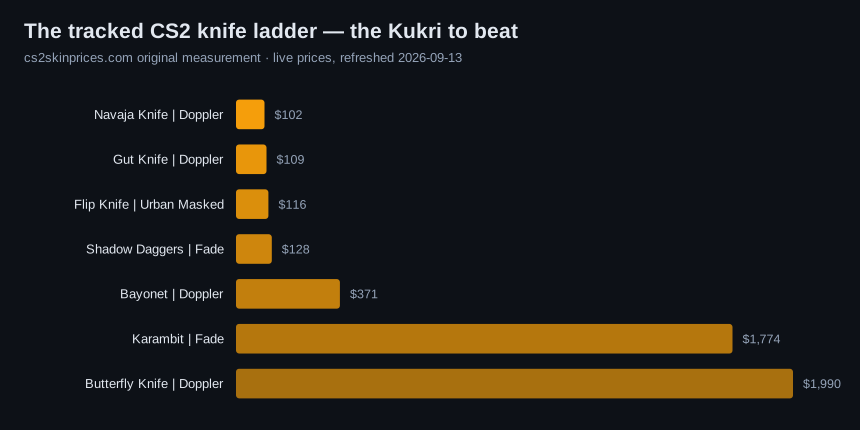
Pricing the Kukri against the ladder that already exists
Any new knife family has to price itself against what already trades, so it is worth seeing the tracked ladder in one view. On the 13 September 2026 refresh the seven knife finishes I follow ran from a Navaja Doppler at $101.77 to a Butterfly Doppler at $1,990 — roughly a 19.55× spread across a single item category.
| Knife | Lowest live listing |
|---|---|
| Navaja Knife | Doppler (FN) | $101.77 |
| Gut Knife | Doppler (FN) | $109.08 |
| Flip Knife | Urban Masked (FT) | $115.81 |
| Shadow Daggers | Fade (FN) | $127.86 |
| Bayonet | Doppler (FN) | $371.20 |
| Karambit | Fade (FN) | $1,773.91 |
| Butterfly Knife | Doppler (FN) | $1,990.00 |
Two things this table tells you that a single price never will. First, the bottom four families cluster within a few tens of dollars of each other — at the entry level you are choosing an animation and a silhouette, not a price point. Second, the jump from Bayonet to Karambit is more than a thousand dollars for no change in mechanical function whatsoever; that gap is pure desirability, and it is remarkably stable. Over the 22 days I tracked, the Karambit Fade moved 2.9% and the Butterfly Doppler 9.4%, while the cheap end moved barely at all in absolute dollars.
Read the Kukri's price against that context rather than in isolation. Our cheapest knife CS2 page covers the bottom of the ladder in detail, and the knives hub has the full family breakdown.
Frequently asked questions
When was the Kukri Knife added to CS2?
It arrived with the Kilowatt Case on February 7, 2024, making it the newest knife family in the game. Every other knife model predates it by years, and several date back to the original case era. It is also the only knife added since CS2 replaced CS:GO.
How much does the CS2 Kukri Knife cost?
Plain camo finishes such as Safari Mesh and Rust Coat sit around $95-122 as of mid-2026, mid-tier finishes land between $100 and $165, and premium finishes like Fade or Marble Fade run $330-470. Doppler gem phases go far higher. All of those are approximate bands that move with market conditions.
Why is Field-Tested Case Hardened the most common kukri listing?
Field-Tested covers the widest float range of any wear band, 0.15 to 0.38, so more copies land in it than anywhere else. That makes it the deepest, most liquid tier for any pattern finish. It is also cheap enough to be an accessible entry into Case Hardened without dropping into the visually rough bands.
Does blue percentage really change the price that much?
Yes, and it is the largest single price factor on Case Hardened. A mostly-blue playside can trade at double or triple a gold-dominant copy at the same float. Because the kukri's blade is wide, coverage reads more strongly on it than on smaller knives, which sharpens the premium further.
Can I get a kukri from a trade-up contract?
No. Trade-up contracts move ten skins of one rarity into one skin of the next rarity up, and Covert is the highest possible output. Knives sit in the Special tier, which no contract reaches. The only routes are opening a Kilowatt Case or buying one.
Is the Kukri Knife a good investment?
Treat it as a purchase, not an investment. The bull case is a single-case origin and a unique silhouette, so supply eventually stops growing. The bear case is that its animation does not drive the demand that keeps premium knives expensive. Buy it because you like it.
What float should I target on a camo kukri?
Around 0.16 to 0.22 for a Field-Tested that still looks tidy, or accept Battle-Scarred on busy patterns like Safari Mesh and Scorched where scratches blend into the design. Smooth finishes such as Blue Steel and Damascus Steel punish high floats badly, so buy those low or skip them.
Is the kukri bigger than other knives on screen?
It is one of the larger models, clearly bigger than the Navaja, Shadow Daggers, Gut Knife, or Falchion, and roughly comparable to a Bowie or Huntsman. That extra blade area is a real advantage for pattern and color finishes, which have more surface to display.
Which kukri finish is the best value?
Night Stripe around $112-140 is the one I keep pointing people toward — it looks deliberate rather than default and costs barely more than the family floor. For a larger budget, a well-patterned Field-Tested Case Hardened near $170 gives you a genuinely distinctive knife without premium-finish pricing.