Cheapest Knife CS2 Sells: The Real Floor Price and How to Buy It

Sukie · Founder & Market Tracker
Sukie has tracked the Counter-Strike skin economy since 2023, maintaining a price-history spreadsheet that covers 400+ skins and testing every major marketplace with her own inventory. She writes and updates every guide on CS2 Skin Prices herself.
Last updated: 2026-08-01
The cheapest knife CS2 sells is a high-float Navaja Knife in a plain camo finish, and as of mid-2026 the floor sits at roughly $65-80 depending on the day and the marketplace you shop. Shadow Daggers and the Gut Knife live in the same basement, usually $70-95 for the least-wanted finishes. Nothing you do with trade-up contracts or clever timing gets you below that line, because the bottom of the knife market is exactly what it looks like: a small, scuffed, entirely real Navaja that somebody else got bored of. The rest of this page covers whether that knife is the one you actually want, which finishes inside each family are truly cheapest, and how to buy without handing $20 to a bad listing.
The Short Answer, With Real Numbers Attached
Every knife in Counter-Strike 2 shares one rarity tier: Special, the gold-name tier. A $70 Navaja and a $4,000 Karambit are identical in rarity terms. The only things separating them are demand for the model and demand for the finish painted on it. There is no cheap rarity of knife, only cheap taste.
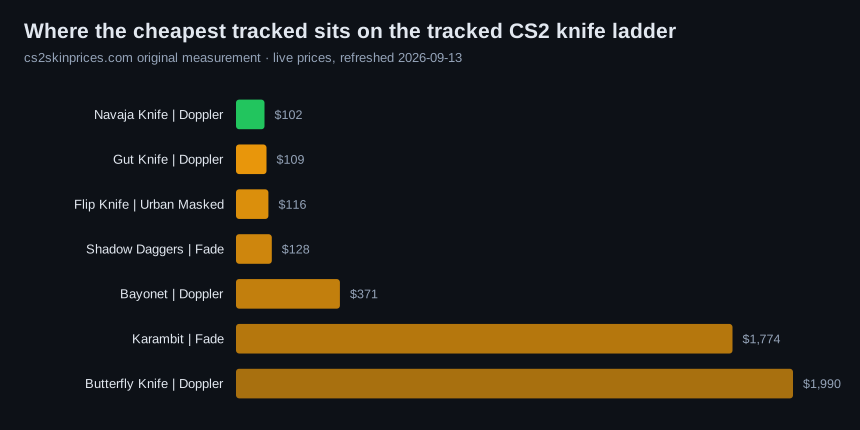
Here is where my spreadsheet has the floor as of mid-2026. Navaja Knife in a camo finish: roughly $65-80. Shadow Daggers: roughly $70-90. Gut Knife: roughly $75-95. Those numbers describe Battle-Scarred and high Field-Tested copies of the least-wanted finishes, bought with patience rather than instant-bought off the first listing. An operation launch or a new case can lift the whole floor 10% for a month and then let it settle, so treat every figure here as a range with a date on it. Sort any knife family by price ascending on the Steam Community Market and you will see the same shape: a shallow puddle of cheap camo listings, then a steep climb.
So the cheapest knife CS2 has on offer costs less than a single mid-tier AWP skin. That is genuinely useful, and it is also the start of a trap, because "a knife" and "a knife you enjoy owning" are not the same purchase.
Why the Navaja, Shadow Daggers, and Gut Knife Sit at the Bottom
Three forces stack up, and understanding them tells you which knives will still be cheap next year.
Supply: they have been dropping for a very long time
The Gut Knife has been in the drop pool since the earliest case era, the Shadow Daggers arrived with the Shadow Case in 2015, and the Navaja came with the Horizon Case in 2018. Years of circulation through heavily opened cases means an enormous number of copies relative to demand. Knife odds are brutal — the Special tier hits at about 0.26% per case, roughly 385 cases or around $958 in keys — but multiply that by hundreds of millions of openings and you still get a crowded marketplace.
Size: you can barely see two of them
The Navaja is a small folding knife that spends most of its life closed, and the Shadow Daggers are two short blades held low and tight to the body. When the knife occupies a corner of your screen for a couple of seconds at a time, physical presence is most of the product, and these models do not have much.
Animation: the inspect is what people are actually buying
The Butterfly flip, the Karambit spin, the Stiletto's snap-out draw — those animations are why those families cost what they cost. The Navaja's flick is quick and clean but tiny; the Gut Knife's inspect is a plain twirl of a wide, tool-shaped blade. Nothing is wrong with any of it, and nothing is memorable either, which is precisely what a floor price measures.
The Cheapest Finish Inside Each Knife Family
Within any family the price ladder runs from plain camouflage patterns at the bottom to color-shifting Dopplers and Fades at the top. If your only goal is the lowest possible number, the finishes you want are Safari Mesh, Forest DDPAT, Boreal Forest, Urban Masked, Scorched, Night, and Stained — the workhorse camos Valve has reused since 2013, and the ones sitting at the front of every price-ascending search.
This table comes from my own tracking spreadsheet and shows the realistic entry point per family, not a single lucky listing. All figures approximate as of mid-2026.
| Knife family | Cheapest common finish | Wear to target | Hedged floor price |
|---|---|---|---|
| Navaja Knife | Safari Mesh | Battle-Scarred | ~$65-80 |
| Shadow Daggers | Forest DDPAT | Battle-Scarred | ~$70-90 |
| Gut Knife | Boreal Forest | Field-Tested | ~$75-95 |
| Kukri Knife | Safari Mesh | Field-Tested | ~$95-125 |
| Falchion Knife | Scorched | Battle-Scarred | ~$100-125 |
| Bowie Knife | Forest DDPAT | Field-Tested | ~$105-135 |
| Huntsman Knife | Urban Masked | Battle-Scarred | ~$115-145 |
| Flip Knife | Urban Masked | Battle-Scarred | ~$125-155 |
| Stiletto Knife | Boreal Forest | Field-Tested | ~$165-205 |
| Butterfly Knife | Scorched | Battle-Scarred | ~$650-900 |
Two things jump out. First, the gap to the second rung is small — $30 more moves you from a Navaja to a Kukri Knife, a far larger and newer model. Second, the Butterfly row is not a typo; its flip animation alone carries a tenfold premium over the floor.
Ugly Cheap Versus Clean Cheap: The Trade-Off Nobody Warns You About
Almost every listing at the absolute floor is Battle-Scarred, and on a knife that means visible rust, dark scratch clusters along the blade, and a handle that reads as grimy rather than worn. Wear tiers run Factory New 0.00-0.07, Minimal Wear 0.07-0.15, Field-Tested 0.15-0.38, Well-Worn 0.38-0.45, Battle-Scarred 0.45-1.00, and knives show that range harder than rifles because the model sits close to the camera and is mostly metal. Checking a CS2 float takes two minutes to learn and is the highest-leverage habit in cheap-knife shopping.
Some finishes carry wear gracefully and some collapse under it:
- Hides wear well: Safari Mesh, Boreal Forest, Forest DDPAT, Scorched — the pattern is already busy and mottled, so scratches blend in.
- Shows wear badly: Blue Steel, Damascus Steel, Ultraviolet, Bright Water. These rely on a smooth, even metal surface, and Battle-Scarred turns it into visual noise.
- Wear is nearly irrelevant: Slaughter and Case Hardened on some models, where the pattern dominates what you actually see.
The rule I use: buying at the floor means buying a busy camo. If you want something smooth and metallic, add $25-40 for a low Field-Tested — around 0.16 rather than 0.35. That is often the difference between a knife you show people and one you quietly re-sell.
Is a Cheap Knife Worth It, or Should You Buy Gun Skins Instead?
Here is the honest version, and it is not what most knife pages tell you. For $80 you can buy a knife you will see for two seconds a round, or a solid AK-47 finish plus a decent M4 — skins that fill your screen for the entire match. In screen time per dollar, gun skins win, and it is not close.
The counter-argument is real too. A knife changes the feel of an inventory in a way gun skins do not, it is the item other players notice in a trade window, and the gold name carries a status weight that has survived a decade of price swings. Floor knives also hold their price band better than mid-tier rifle skins, because that floor is set by a rarity nobody can manufacture. Independent coverage such as the 2026 CS2 market report has tracked the same stability across multiple cycles.
My actual advice, after watching a lot of people make this purchase: if you have never owned a full loadout, buy the gun skins first. If you already have a loadout you like and the knife is the missing piece, a floor Navaja is a reasonable $75. Just do not expect it to feel like the knives in highlight videos, because those are $900 Butterflies.
How to Actually Buy One Without Overpaying
The gap between a good and a bad purchase at this price point is routinely $15-25, which is 20-30% of the item. Five habits close that gap.
- Never instant-buy the first listing. The cheapest knife CS2 listings turn over constantly, and the bottom two or three are usually priced by people who want out today. Watch a family for a few days to see the real floor.
- Check the float, not just the wear label. A 0.16 Field-Tested and a 0.37 Field-Tested carry the same tag and look nothing alike. On camo the difference is smaller, but never zero.
- Compare at least two venues. Steam bakes in a 15% fee; third-party markets price differently because their liquidity and payout rules differ. Neither is universally cheaper, and the spread moves.
- Remember that Steam funds are one-way. Money in your Steam wallet buys games and skins and never comes back out as cash. If you might liquidate later, that should shape where you buy.
- Treat any offer below the floor as a scam. Nobody sells a $75 knife for $40 out of kindness. Fake middlemen, API-key theft, and lookalike trade windows are the standard playbook — common CS2 skin scams covers the patterns worth memorizing first.
One note on timing: in late June 2026 I logged the Navaja camo floor dipping into the high $50s for about four days during a broad market pullback, then snapping back above $70. Floors move, and the move is usually short. If you are patient enough to sit on a watchlist, that is where the discount lives.
The Upgrade Path From the Floor
A floor knife is not a dead end, and treating it as a first rung rather than a final answer makes the purchase far easier to justify. The ladder as I see it in mid-2026:
Rung one, $65-100: camo Navaja, Shadow Daggers, or Gut Knife. You own a gold name. Nothing more.
Rung two, $130-200: small models in premium finishes — Navaja Doppler, Shadow Daggers Fade — or a plain finish on a bigger model like the Kukri or Flip. Here a knife starts looking deliberate rather than accidental.
Rung three, $250-450: mid-size models in good finishes, or a clean Stiletto, where the animations get noticeably better.
Rung four, $650 and up: Butterfly, Karambit, M9 Bayonet. The famous animations, the famous prices.
Moving between rungs costs less than you would think if you sell rather than accumulate, though the 15% Steam fee eats a chunk of every step taken inside Steam. Browse the full CS2 knives guide for how the families compare, or start from the CS2 skin prices homepage if you are still mapping where knives sit against cases and floats. And if you are tempted to gamble your way up, read the real case opening odds first.
Frequently asked questions
What is the single cheapest knife in CS2 right now?
A Battle-Scarred Navaja Knife in Safari Mesh or a similar camo finish, typically around $65-80 as of mid-2026. Shadow Daggers in Forest DDPAT sit just above it at roughly $70-90. Those two families trade places at the bottom depending on the week, so check both before buying.
Can I get a knife from a trade-up contract to save money?
No. Trade-up contracts convert ten skins of one rarity into a single skin of the next rarity up, and Covert is the ceiling. Knives sit in the Special tier, which trade-ups cannot reach at all. Any site claiming otherwise is running a scam.
Is it cheaper to open cases or just buy the cheapest knife CS2 has?
Buying is cheaper by a wide margin. Knife odds are about 0.26% per case, roughly 385 cases and around $958 in keys on average — and the knife you get is random, so it might be a $70 Navaja anyway. Paying $75 for the exact knife you want is strictly better.
Do cheap knives lose value over time?
Historically the floor has been sticky rather than falling, because supply only grows through case openings while the player base keeps turning over. Individual finishes drift and short 10-15% pullbacks happen, but the bottom of the knife market has been one of the steadier bands in the game. Nothing here is a guarantee.
Why is the Navaja so much cheaper than the Butterfly if they are the same rarity?
Rarity controls how rare the drop is, not what people want. The Butterfly's flip animation and large blade make it the most desirable mainstream model, so its floor sits around $650-900 while the Navaja's sits near $70. Both are gold-name Special items from the same 0.26% odds.
Should I buy Battle-Scarred or stretch for Field-Tested?
On busy camo patterns like Safari Mesh and Boreal Forest, Battle-Scarred is fine and saves real money. On smooth metallic finishes like Blue Steel or Ultraviolet it looks genuinely bad, and the extra $25-40 for a low Field-Tested is worth it. Match the wear to the finish.
Are third-party marketplaces cheaper than Steam for budget knives?
Sometimes, and the direction flips week to week. Steam bakes a 15% fee into its pricing but has the deepest listing pool; third-party venues often show lower sticker prices while adding fees, payout delays, and risk. Compare both for the float you want.
Is a $75 knife worth it if my gun skins are all default?
Probably not yet. Gun skins occupy your screen for the entire round while a knife shows for a second or two, so $75 spent on an AK and an M4 finish changes far more of what you look at. Buy the knife once your main weapons are covered.