Karambit Fade Price Guide: Fade Percentages, Full Fade, and What Drives Value

Sukie · Founder & Market Tracker
Sukie has tracked the Counter-Strike skin economy since 2023, maintaining a price-history spreadsheet that covers 400+ skins and testing every major marketplace with her own inventory. She writes and updates every guide on CS2 Skin Prices herself.
Last updated: 2026-07-31
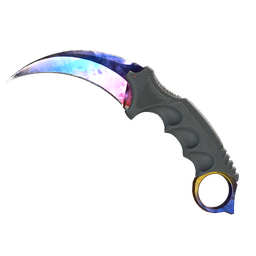
Live Karambit | Fade prices
| Item | Lowest price | Cheapest at | Other markets |
|---|---|---|---|
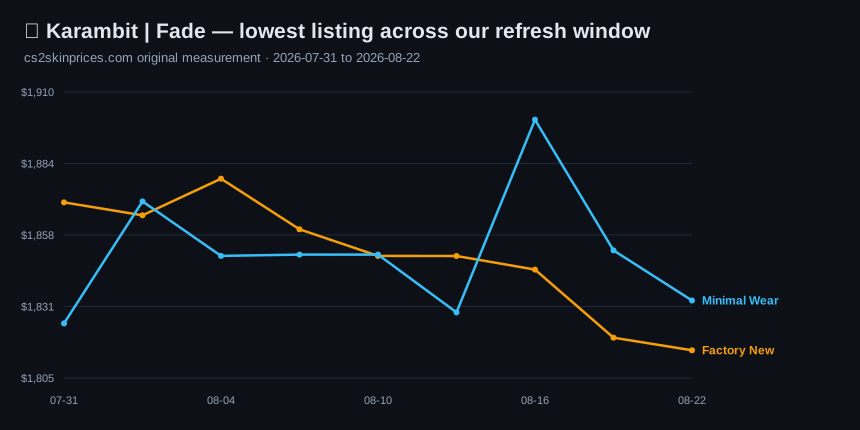
| ★ Karambit | Fade (Factory New) | $1,773.91 | CSFloat | CS.MONEY $1,852.57 · Skinport $1,880.62 · Market.CSGO $2,052.64 |
| ★ Karambit | Fade (Minimal Wear) | $1,900.00 | CSFloat | Market.CSGO $2,800.00 |
Item images: Counter-Strike 2 © Valve Corporation, via Steam Community Market.
The karambit fade price is the closest thing the CS2 knife market has to a stock index. When knife demand heats up, this is the blade that moves first; when the market cools, its listings are where the discounts show up earliest. A clean Factory New copy has traded in the several-thousand-dollar range as of mid-2026, but that single headline number hides a surprisingly intricate pricing system underneath — one built on fade percentages, pattern seeds, and the scarcity of the ancient cases it drops from.
Unlike most skins, where float value does the heavy lifting, two Karambit Fades with identical floats can differ in price by four figures. The variable that matters is the fade percentage: how completely the pink-to-purple-to-gold gradient covers the blade. The market has built an entire tier system around that number, from "80% fade" budget copies up to the coveted Full Fade, and understanding those tiers is the difference between paying a fair price and overpaying by a very expensive margin.
I have tracked this knife weekly in my price spreadsheet since late 2023, watching individual listings sit, sell, and relist across marketplaces. This page walks through how the finish actually works, what each fade tier is worth relative to the base, where the knife comes from, how to catch misrepresented listings before you pay, and what to consider instead if the price tag is simply out of reach. Live price data appears alongside this guide, and our full skin price database tracks hundreds more items; treat every figure in the text as approximate, because this market moves.
Why This Knife Is the Market's Benchmark
Every market has a reference asset, and in CS2 knives that role belongs to the Karambit Fade. Three properties earned it the job.
First, it pairs the most iconic knife shape in Counter-Strike with one of the oldest and cleanest finishes. The curved karambit silhouette is instantly recognizable in-game — the inspect animation alone has sold thousands of these — and Fade was among the original knife finishes shipped in 2013, giving it thirteen years of continuous price history that traders actually reference.
Second, its supply is effectively frozen. It drops only from case pools that stopped dropping to players years ago, so the population grows at a trickle while some copies exit the market permanently into locked accounts and long-term collections.
Third, it is liquid for its price class. Most four-figure items sit on listings for weeks; a fairly priced Karambit Fade tends to move in days, because there is always a buyer waiting for the benchmark knife. That liquidity is why traders quote it the way currency traders quote a major pair — and why the broader CS2 skin price market often takes its temperature from this one blade.
How the Fade Finish Actually Works
Fade is an anodized gradient — pink flowing through purple into gold — applied across the blade. What most buyers don't realize is that the gradient's position is not fixed: the pattern seed assigned when the knife is created shifts where the gradient sits on the blade. Some seeds push the full three-color spread across the visible face; others cut the gradient off early, leaving more plain gold and less of the prized pink-purple transition.
The community distills this into a fade percentage, typically quoted from about 80% up to 100%. Higher percentages mean more of the gradient survives onto the blade's display side. Third-party inspect tools calculate the percentage from the seed, which is why serious buyers never rely on a listing's title alone.
Float, meanwhile, is nearly a non-factor. The Karambit Fade's float range is capped at roughly 0.00–0.08, which means practically every copy in existence is Factory New, with a thin sliver of technical Minimal Wear at the very top of the range. When every copy is clean, condition stops differentiating price — which is exactly why the fade percentage system took over the job that float performs elsewhere. If you want the full background on how float works across normal skins, our float guides cover the mechanics in depth.
Fade Percentage Tiers and What They Cost
The market prices fade tiers with surprising consistency. The table below reflects the premium structure I have observed across marketplaces through 2025 and 2026 — every figure is approximate and hedged, because spreads shift week to week, but the shape of the ladder holds.
| Fade tier | What it means | Hedged premium over base listings |
|---|---|---|
| 80–84% | Gradient cut off early; mostly gold blade | The de facto floor — often the cheapest listings, sometimes modestly below typical mid-tier prices |
| 85–89% | Partial gradient; purple visible but limited | Around the base price; most listings cluster here |
| 90–94% | Strong gradient with clear pink and purple | Roughly 5–10% over base, varying with demand |
| 95–99% | Near-complete gradient; visually close to full | Roughly 10–20% over base |
| Full Fade (100%) | Complete gradient across the blade's display face | Often 20–40% or more over base, with standout seeds commanding even higher |
Two practical notes. The jump from 95–99% to Full Fade is the steepest step on the ladder relative to the visual difference, which is tiny — Full Fade is a collector's designation more than an aesthetic upgrade. And low-percentage copies are not "damaged goods": an 80% fade is the same knife with more gold, and for buyers who actually prefer the gold look, it is the best value on the ladder.
Where the Karambit Fade Comes From
Fade-finish knives belong to the oldest generation of case pools — the CS:GO-era containers from 2013 and 2014, such as the original CS:GO Weapon Case line and the Operation Bravo Case. These cases left the active drop pool long ago, and their prices reflect it: the rare-drop cases that can produce a Fade knife now cost substantial money per case before you even buy a key.
Run the math and unboxing one on purpose is close to irrational. Gold-tier items drop at 0.26% — about 1 in 385 cases — and with keys at $2.49 each, the expected key spend alone averages roughly $958 per knife, before hundreds or thousands of dollars in old-case costs, and with no guarantee the gold you hit is a Karambit, or a Fade. The odds mechanics are covered in depth in our case opening odds breakdown, and independent references like SteamAnalyst's case odds guide document the same probabilities.
The practical takeaway: essentially everyone who owns this knife bought it on a marketplace, and the frozen supply from retired cases is a structural reason the karambit fade price has trended upward across eras rather than reverting when hype cycles fade.
Spotting Misrepresented Fade Percentages
Because the fade tier moves the price so much, listings misstate it constantly — sometimes from ignorance, sometimes not. A knife titled "95% FADE" with a seed that inspect tools score at 89% is a real and recurring pattern; I flagged three separate listings like that in a single browsing session in February 2026, each priced a tier above what its seed supported.
Protect yourself with a three-step check before any purchase:
- Pull the actual inspect link and view the knife in 3D, rotating to the display side. If a listing hides or breaks the inspect link, walk away — there is no honest reason to obstruct inspection on a four-figure item.
- Verify the seed against a fade calculator. Third-party inspect tools read the pattern seed and compute the percentage independently of whatever the seller typed. Our walkthrough on how to check CS2 float covers the same inspection workflow, which surfaces seed and float together.
- Compare against tier pricing, not the listing's own framing. A "discounted" 98% fade priced like a 92% is usually just a 92%.
None of this takes more than five minutes, and on an item this expensive, five minutes of verification is the cheapest insurance available.
Price History: 2020 to 2026
The arc of this knife's value over the past six years mirrors the whole item economy, which is exactly what you would expect from a benchmark. All figures below are approximate ranges from my tracking and public price histories, not exact quotes.
- 2020–2021: The pandemic-era boom pulled the whole knife market upward, and Factory New copies that had long sat under a thousand dollars pushed well above it as new money flooded into skins.
- 2022: A cooldown year. Broader risk assets fell, skin prices sagged with them, and Fade listings drifted down from their highs — a useful reminder that knives are not immune to macro sentiment.
- 2023–2024: The CS2 announcement and release ignited the strongest rally in the item economy's history. Benchmark knives roughly doubled from their 2022 lows as players returned and speculation surged.
- 2025–2026: Consolidation at a high plateau, with a notable sharp correction in spring 2025 that knocked broad double-digit percentages off knife prices within weeks before a partial recovery. As of mid-2026, clean FN copies sit in the several-thousand-dollar range, with Full Fades above that. The SteamAnalyst 2026 market report is a good independent snapshot of where the market landed.
The through-line: dips have historically been bought. That is not a promise it continues — but it is why sellers rarely panic-list this knife.
If It's Out of Budget: Honest Alternatives
Most people who research the karambit fade price close the tab when they see it. That is a reasonable response, and there are genuinely satisfying ways to redirect the budget.
Same finish, cheaper blade. Fade exists on many knife types, and shapes like the Gut, Navaja, and Shadow Daggers deliver the identical pink-purple-gold gradient for a fraction of the cost. You lose the karambit silhouette and inspect animation, not the colors.
Same blade, cheaper finish. Karambits in finishes like Ultraviolet, Rust Coat, or Safari Mesh keep the shape and animation everyone actually notices in-game, often for well under half the cost of a Fade.
Skip the knife premium entirely. A knife-plus-gloves loadout built strategically can look more distinctive than a lone expensive blade — our roundup of knife and gloves combos under $100 shows how far a constrained budget stretches when you stop paying the karambit tax. There is no wrong answer here; there is only what the money is worth to you.
Frequently asked questions
How much does a Karambit Fade cost right now?
As of mid-2026, Factory New copies generally trade in the several-thousand-dollar range, with the exact figure depending on fade percentage, marketplace, and week. Full Fade examples command a meaningful premium above standard copies. Check the live price data on this page and always compare multiple marketplaces before buying.
What does fade percentage mean on a Karambit?
It measures how much of the pink-purple-gold gradient appears on the blade's display side, determined by the knife's pattern seed. Percentages are quoted from roughly 80% to 100%. Higher percentages show more of the full gradient and command higher prices, with Full Fade (100%) at the top of the ladder.
Is a Full Fade Karambit worth the premium?
Visually, the gap between a 97% fade and a Full Fade is small — most people could not pick them apart in-game. The premium, often 20–40% or more, is really about collectibility and resale story. If you are buying to use, a 90–95% copy is the better value; if you are buying to collect, Full Fade holds its designation forever.
Can a Karambit Fade be anything other than Factory New?
Rarely. Its float range is capped at roughly 0.00–0.08, so almost every copy rolls Factory New, with a thin band of technical Minimal Wear possible at the top of the range. Because nearly all copies are clean, condition plays almost no role in pricing — fade percentage does that work instead.
Which cases drop the Karambit Fade?
It comes from the earliest CS:GO-era case pools, such as the original CS:GO Weapon Case line and the Operation Bravo Case, which no longer drop to players. Those cases now cost significant money on the market themselves, which is why opening for this knife specifically is far more expensive than simply buying one outright.
How do I verify a listing's claimed fade percentage?
Open the item's inspect link, note its pattern seed, and run the seed through a third-party fade calculator rather than trusting the listing title. Sellers overstate tiers often enough that this check is essential on any Fade purchase. If a seller obstructs inspection of a four-figure knife, treat that as disqualifying and move on.