Butterfly Knife Fade: Prices by Wear, Why Steam Has None for Sale, and What Fade % Really Means

Sukie · Founder & Market Tracker
Sukie built and maintains the price feed behind CS2 Skin Prices, which has recorded the lowest live listing for a fixed list of skins, cases and knives every three days since 31 July 2026, and she tests marketplaces with her own inventory. She writes and updates every guide on CS2 Skin Prices herself.
Last updated: 2026-11-08
The Butterfly Knife fade is the Butterfly Knife (the balisong that Valve added to Counter-Strike in July 2014) in the Fade finish. In Valve's own words, the blade is "painted by airbrushing transparent paints that fade together over a chrome base coat". It only drops from the Operation Breakout Weapon Case. On 17 October 2026 the cheapest Factory New copy listed at $1,899.61 on third-party marketplaces, and on 29 October 2026 the Steam Community Market had no copies for sale at all.
Those two facts are what this page is about. Below are the prices by wear and StatTrak, taken from a dated multi-marketplace snapshot and from Steam's own sales record. I also explain why Steam ran dry, and what a "fade percentage" actually is, using the open-source calculator that CSFloat and Skinport use. That section includes how all 1,001 Butterfly pattern seeds spread across the 80–100% scale. Then come the case it drops from and how it lines up against the Karambit Fade. For the whole Butterfly family, with every finish priced, see the CS2 Butterfly Knife guide. This page sticks to the Fade.
What does a Butterfly Knife Fade cost?
On the multi-marketplace snapshot I took on 17 October 2026, a Factory New Butterfly Knife | Fade had a cheapest listing of $1,899.61. That price was on CSFloat, which held 286 of the 1,197 Factory New copies listed across the venues the snapshot reads. Buff.market was 39 cents behind at $1,900.00, with 602 listings. The snapshot comes from CSMarketAPI and covers CSFloat, Skinport, market.csgo, CS.MONEY and Buff.market. It does not include Steam, so for Steam I went to Valve's market directly on 29 October 2026.
On Steam the honest answer is "nothing is for sale". The table puts both venues side by side, together with the last sale Steam recorded for each version:
| Version | Cheapest third-party listing, 17 Oct 2026 | Steam listings, 29 Oct 2026 | Last Steam sale (recorded price) | Steam sales in 2026, to 29 Oct |
|---|---|---|---|---|
| Factory New | $1,899.61 (CSFloat; 1,197 listings across venues) | 0 | $1,873.83 on 23 Oct 2026 | 18 |
| Minimal Wear | not in the snapshot | 0 | $1,653.25 on 15 Sep 2026 | 5 |
| StatTrak™ Factory New | not in the snapshot | 0 | $1,556.01 on 9 Aug 2026 | 3 |
Read it carefully, because each column measures something different. The third-party figure is an asking price: the cheapest copy someone was willing to sell on that day. The Steam columns are completed sales taken from the price history Steam publishes on the item's market page, so each one is a price a buyer actually paid on Steam. With fewer than two dozen Steam sales a year, a single sale tells you very little about a "price". The StatTrak sale at $1,556.01, for example, is one trade on one day. It does not mean StatTrak is cheaper than the plain version.
Each sale also had its own fade percentage, and that matters more than wear on this knife (see below). So a $1,653 Minimal Wear sale next to an $1,874 Factory New sale is not a clean wear discount either. If you want a current number, check the third-party venues on the day you buy. Use this table to learn the shape of the market, not the exact price.
Which wear tiers and StatTrak versions exist?
Steam's market page for the Butterfly Knife | Fade groups exactly three items: Factory New, Minimal Wear and StatTrak™ Factory New. All three have recorded sales going back to 2 July 2014, the first day in the history. Searching the full Steam catalogue of 146 Butterfly Knife item names on 29 October 2026 turned up no Field-Tested, Well-Worn or Battle-Scarred Fade, and no StatTrak Minimal Wear.
I will be precise about what that proves. It shows which versions have traded on Steam. It is not a float range I have checked against a primary source, so I am not quoting a float cap here. In practice, though, Factory New is the version that actually trades. Since July 2014 Steam has recorded 27,800 Factory New sales, 2,492 StatTrak Factory New sales and 1,019 Minimal Wear sales. Minimal Wear copies are rare enough that Steam recorded no sale of one at all in 2024.
For a buyer, this means wear is not where the price differences come from. Two Factory New copies can differ by hundreds of dollars because of how the gradient sits on the blade, and that is what the fade percentage measures. If you want the general mechanics of wear first, the Factory New vs Minimal Wear vs Field-Tested guide covers them. For this one finish, though, wear is close to a non-issue.
Why are there no Butterfly Fade listings on Steam?
The Butterfly Fade costs about as much as Steam lets anyone hold. Valve's Community Market FAQ sets two limits. First, Steam Wallet balances are capped at $2,000. Second, "the maximum price of a single listing on the market" is $1,800. The FAQ adds that a seller cannot list an item if their existing wallet balance plus the sale price "would together exceed the $2000 limit".
Put the 17 October third-party floor of $1,899.61 next to those numbers. To sell a Factory New Fade on Steam at around its market value, the seller would have to start with a nearly empty wallet. The buyer would need close to $1,900 of Steam Wallet funds, almost the whole cap. Everywhere else, the same knife can be sold for money you can actually withdraw. Most owners take that option, and on the morning of 29 October not one copy of any version was listed on Steam.
One caveat I cannot settle from Valve's text. Steam's own history records Butterfly Fade sales above $1,800: 10 of the 18 Factory New sales in 2026 were recorded higher, the top one at $2,076.26 on 20 April. The FAQ does not say whether its $1,800 figure is measured before or after the market fee. So I do not treat $1,800 as a hard limit on what a buyer pays. The pattern is clear without that detail, though: the closer the knife's price got to the wallet limit, the less it traded on Steam. That is the next section.
Steam's own record, 2014 to 2026
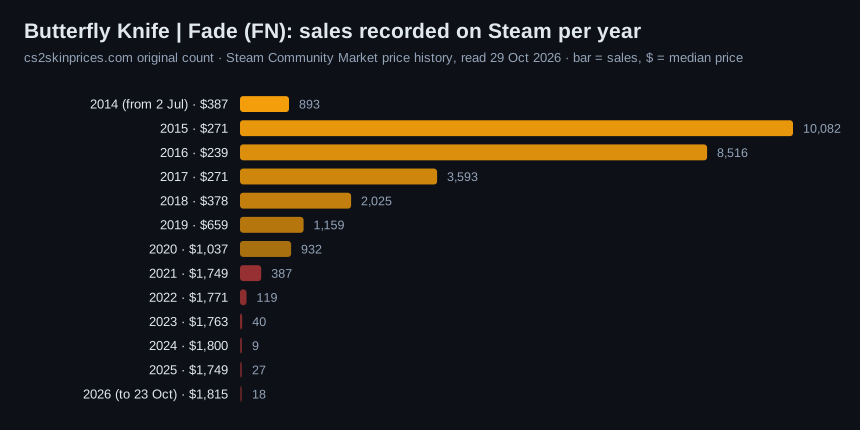
Steam publishes the price history of every market item, and for this knife it runs back to the first day of Operation Breakout. I counted the recorded sales year by year for the Factory New version and took the median recorded price for each year:
- 2015: 10,082 sales, median $271.19. This was the busiest year.
- 2016: 8,516 sales at a median of $238.82, the cheapest year in the record.
- 2019: 1,159 sales, median $659.29.
- 2020: 932 sales, median $1,037.08.
- 2021: 387 sales, median $1,749.27. The price was now close to the wallet limit.
- 2024: 9 sales, median $1,799.75.
- 2026, to 23 October: 18 sales, median $1,815.43.
The chart shows every year. The bars track the price closely. Once the median passed about $1,700 in 2021, Steam volume fell from hundreds of sales a year to a few dozen, and it never recovered. That does not mean demand fell. The 17 October snapshot still counted 1,197 Factory New copies for sale elsewhere, and that is only the asking side. The trading simply moved off Steam.
Two practical notes on reading Steam's history. First, it includes a few nonsense entries, such as a recorded price of $0.01 in 2025, which is why I use medians rather than averages. Second, the 2015 median is not a price anyone can get today. Recent sales run at nearly seven times the 2015 median. If you are thinking about the knife as an investment, the CS2 skin price history page explains why a long rise like this one says nothing reliable about the next year.
What does "fade percentage" actually mean?
A fade percentage is a number the community calculates. It is not a stat in the game. The maintainers of the open-source CS2 Fade Percentage Calculator say so plainly: "Fade percentages don't really exist in CS2 itself." What the game does have is a paint seed (also called the pattern index), a value from 0 to 1000 assigned to every copy. The seed sets how the paint is positioned on the blade.
The calculator's documentation explains the mechanics. The seed determines an X offset, a Y offset and a rotation for the pattern, using an algorithm Valve open-sourced. On most Fade skins the X and Y offsets are the same for every seed, so the only thing that changes from copy to copy is the rotation. The calculator turns each seed into its rotation value. It then scales those values from 80 to 100, so the best rotation becomes a 100% Fade and the worst becomes an 80% Fade.
Two consequences follow, and both cost buyers money:
- The scale is a convention. "80%" does not mean 80% of the blade is coloured. It means the worst rotation the finish can have on this model. A "low" percentage is still a full Fade knife, just with the gradient sitting differently.
- Venues can disagree. The README lists CSFloat, Skinport, CSGOSKINS.GG, SkinsMonkey, SkinBid, BitSkins and GamerPay as sites that use this open-source algorithm. It names CS.MONEY, BUFF163, BUFF Market, BroSkins and CS.DEALS as sites using their own methods, "probably based on image analysis". Those sites can give the same seed a different percentage. A "97% Fade" on one site and a "97% Fade" on another may not be the same knife.
The seed is what you can check. Every float-checking tool reads it from the item's inspect link, and the how to check CS2 float guide walks through those tools. Once you have the seed, you can look up its percentage on the open-source scale yourself instead of trusting a listing title.
How are the 1,001 Butterfly seeds spread across the fade scale?
Roughly evenly, and that tells you how scarce the high end is. I ran version 2.0.0 of the calculator above for the Butterfly Knife on 29 October 2026, which assigns a percentage to every seed from 0 to 1000, and counted how many seeds fall in each band:
| Fade percentage band | Seeds | Share of all 1,001 seeds |
|---|---|---|
| 80.00–84.99% | 252 | 25.2% |
| 85.00–89.99% | 248 | 24.8% |
| 90.00–94.99% | 240 | 24.0% |
| 95.00–97.99% | 152 | 15.2% |
| 98.00–98.99% | 47 | 4.7% |
| 99.00–99.99% | 61 | 6.1% |
| 100% (seed 763 only) | 1 | 0.1% |
A few things stand out:
- Only seed 763 is a 100% Fade on a Butterfly. Seed 412 is the worst, at 80%.
- The top of the scale is thin. Only 62 of the 1,001 seeds (6.2%) reach 99% or higher, and 27 reach 99.5% or higher.
- The bottom half is cheap to reach. Exactly 500 seeds sit below 90%.
A seed is assigned to each copy when it is created, and the calculator's maintainers describe it as random. So the share of seeds in a band is a reasonable guide to how common that band is among new copies. It is not a count of how many copies exist, which nobody publishes.
These counts are about supply. What the market pays for each band is a separate question, and I do not have a measured source for the premium on a high-percentage Butterfly. So I am not printing one. Venues that use the open-source scale let you filter by percentage, so you can see the current asking price for a given band yourself.
How does it compare with the Karambit Fade?
The Butterfly Fade costs more, trades more on Steam, and has its best and worst seeds the opposite way round from the Karambit. On the same day and by the same method, the two Factory New floors were $1,899.61 for the Butterfly and $1,524.68 for the Karambit (the cheapest third-party listings on 17 October 2026). That puts the Butterfly about 25% higher. On the 7 November 2026 refresh of my price feed, a Factory New Karambit Fade listed at $1,465 and a Minimal Wear one at $2,003. The Butterfly Fade is not in that feed, so I cannot give you a live Butterfly figure next to it.
The seed comparison is the part most guides get wrong. In the same calculator, the Karambit's 100% seed is 412 and its 80% seed is 763, exactly the reverse of the Butterfly. The two blades are modelled differently, so the same rotation puts the gradient in opposite places. A seed number that is famous on one knife says nothing about the other. Check every seed on the model you are actually buying.
On Steam, both knives went the same way. Steam recorded 5,671 Factory New Karambit Fade sales since 2014, against 27,800 for the Butterfly. In 2026 so far, the Karambit has 12 recorded Factory New sales and the Butterfly 18. Neither had a Factory New copy listed on Steam when I checked their market pages on 29 October 2026. So the choice between them comes down to the knife you want, not where you can buy it. The Butterfly has the flip animation, the Karambit costs less, and both have to be bought off Steam.
Which case drops the Butterfly Knife Fade?
Only the Operation Breakout Weapon Case. The Counter-Strike Wiki's Operation Breakout Weapon Case entry lists the case's special item as the Butterfly Knife in the original finish set, with 13 Butterfly items: the vanilla knife plus Blue Steel, Boreal Forest, Case Hardened, Crimson Web, Fade, Forest DDPAT, Night, Safari Mesh, Scorched, Slaughter, Stained and Urban Masked. Steam's item data agrees, tagging the Butterfly Fade with "The Breakout Collection".
The three other cases that carry a Butterfly do not carry this finish. According to the wiki, the Spectrum and Spectrum 2 cases (2017) give it Chroma finishes such as Doppler and Marble Fade, and the Operation Riptide Case (2021) gives it the Gamma set. A Marble Fade is a different item, even though the names overlap.
On 29 October 2026 the cheapest Operation Breakout Weapon Case on Steam was $10.24, before the key. Valve's published odds put any gold item at 0.26% per opening, about one in 385 opens. Valve does not publish how that 0.26% is split across the 13 Butterfly items, so I will not guess at the odds of a Fade specifically. The CS2 case opening odds page explains the tiers.
There is one other route. Since Valve's 22 October 2025 update, five regular Covert skins can be traded up for a knife or gloves item "from a collection of one of the items provided". The Breakout Collection's Coverts are the P90 Asiimov and the M4A1-S Cyrex. Valve has published no odds for which finish a knife trade-up returns, so this is a chance at a Butterfly, not a Fade. The CS2 knife trade-up guide covers the contract.
Buying one: what to check before you pay
Buy it off Steam, check the seed yourself, and know that recent trades can be reversed. On a knife this expensive, a few checks are worth the time:
- Get the seed, not the title. Open the inspect link in a float checker, read the paint seed, and convert it on the open-source scale. If a listing says "98%" and the seed comes out at 91%, the venue is probably using its own image-based method (see above).
- Compare Factory New with Minimal Wear. Minimal Wear copies are scarce, and with so few on sale they do not always trade below Factory New. Check both before assuming the lower tier is cheaper.
- Don't go by Steam's last sale. With 18 Factory New sales in ten months, Steam's "recent" price is a handful of trades. The day's third-party listings tell you more.
- Understand trade reversal. Since Valve's 16 July 2025 update, Counter-Strike item trades from the last seven days can be reversed after a scam or a compromised account. Valve's post does not explain what that means for the other side of a reversed trade, so read the CS2 skin scams guide before trading for a knife this valuable.
- Never unbox for it. One-in-385 odds on a gold item, spread across 13 Butterfly items, are a reason to buy outright. This site does not recommend case-opening or gambling sites of any kind.
If the price is out of reach, the CS2 knives hub lists every family with its measured floor, and the cs2skinprices.com homepage has the live price tables.