Lowest Float CS2 Skins: What Those Tiny Numbers Are Worth

Sukie · Founder & Market Tracker
Sukie has tracked the Counter-Strike skin economy since 2023, maintaining a price-history spreadsheet that covers 400+ skins and testing every major marketplace with her own inventory. She writes and updates every guide on CS2 Skin Prices herself.
Last updated: 2026-08-27
Chasing the lowest float CS2 has produced for a given skin is a hobby inside a hobby. The wear value assigned at unboxing runs from 0.00 to 1.00, and while the visible difference between 0.001 and 0.03 is nothing — both render as pristine Factory New — the price difference can be several multiples. Collectors pay for a number they will only ever read on a screen, and the market cheerfully accommodates them.
This page explains what "lowest float" means in practice, why those premiums exist, what they actually look like in dollars across the wear bands, how people hunt low numbers without wasting weeks, and where the premium turns from real scarcity into marketing.
What "Lowest Float" Actually Means
Two different claims hide behind the phrase, and conflating them is where money gets wasted.
The first is the lowest float in existence for that skin — the single known copy with the smallest wear value anyone has recorded. These are tracked, argued over, and occasionally beaten when a new copy surfaces. There is no registry that Valve maintains; the record is whatever the community has found and indexed.
The second, far more common claim is a low float relative to the skin's own range. That is the version that matters for ordinary purchases, and it requires knowing the skin's actual minimum. Many finishes are capped and never reach zero. The AK-47 Redline, for example, starts around 0.10, so a Redline can never be Factory New at all and its "lowest" copies sit at the floor of Minimal Wear. Fade finishes on knives run the opposite way, capped so low that virtually every copy is Factory New — which means "Factory New Fade" describes almost the entire population rather than a distinction.
So the honest version of the question is never "is this a low float." It is "is this low for this skin," and the only way to answer it is to read the value against the finish's own minimum and maximum. The CS2 float chart lays out both the standard tier boundaries and how caps bend them.
Why Anyone Pays for Digits They Cannot See
Nothing about a 0.0003 copy looks different from a 0.04 copy in a firefight, in an inspect view, or in a screenshot. The premium is not visual, and pretending otherwise leads people to buy the wrong things.
The number is not for you. It is for the next person who looks it up.
What buyers are actually purchasing is verifiable scarcity. Wear is permanent, publicly checkable by anyone with the inspect link, and impossible to manufacture — you cannot polish a skin into a better number, and no amount of money creates a copy that was not unboxed. That combination is rare in a digital economy, and it behaves the way rare, provable, non-reproducible things usually behave.
There is a status layer on top. Low-float inventories get shared, ranked, and discussed, and a copy sitting inside the top handful ever recorded carries a story that a merely nice skin does not. Some marketplaces reinforce this by displaying a global rank next to each listing, which turns a private detail into a leaderboard position — and leaderboards reliably create willingness to pay. The 2026 SteamAnalyst market report notes the same dynamic in how collector-tier items decoupled from ordinary skin pricing.
Liquidity is the catch. Ordinary skins have thousands of potential buyers; a record-tier float has a few dozen, and they are not all shopping at once. That is the trade every low-float buyer makes, whether or not they think about it.
What the Premium Looks Like
The figures below come from my own tracking across mainstream, liquid skins — popular rifle finishes and knives with deep listing pools. They are multiples of the ordinary price for that same skin and tier, hedged deliberately, because premiums vary enormously by how collected a particular skin is.
| Float band | Typical premium over the normal tier price | Who is buying |
|---|---|---|
| Below 0.001 (record chase) | 5x to 50x or more on heavily collected skins | Record collectors and showcase inventories |
| 0.001 - 0.005 | Roughly 2x to 6x | Serious low-float collectors |
| 0.005 - 0.015 | Roughly 1.4x to 2.5x | Collectors and patient traders |
| 0.015 - 0.04 | Roughly 1.1x to 1.4x | Ordinary buyers who care about the detail |
| 0.04 - 0.07 (upper Factory New) | Baseline - this is the normal FN price | Almost everyone |
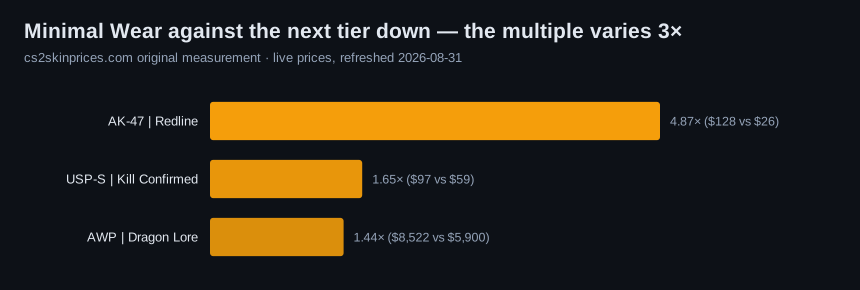
| 0.070 - 0.080 (Minimal Wear floor) | Roughly 1.15x to 1.4x over mid-tier MW | Value buyers who want near-FN looks for less |
| 0.150 - 0.165 (Field-Tested floor) | Roughly 1.1x to 1.3x over mid-tier FT | Budget buyers chasing near-MW looks |
| Capped-minimum skins sitting at their floor | Roughly 1.0x to 1.2x | Informed buyers only; sellers often oversell this one |
Notice where the table stops rewarding you. Below about 0.015 the premium is collector money and the buyer pool narrows sharply. Between 0.07-0.08 and 0.15-0.165, by contrast, the premium buys something you can genuinely see, which is why the tier-floor bands are the only low-float purchases I would call broadly sensible. The Minimal Wear guide covers that sweet spot in detail.
How Low-Float Hunting Works in Practice
People imagine lowest float CS2 hunting as luck. It is mostly filtering and patience.
- Pick one skin. Hunting across a watchlist of thirty finishes produces nothing. Depth beats breadth, because you need to know what a good number looks like for that specific skin.
- Learn its real range. Find the finish's minimum and maximum before you look at a single listing, so you can tell an impressive number from an ordinary one.
- Use venues that expose wear. Marketplaces that display exact values and let you sort ascending turn hours of manual checking into one query. The Steam Community Market does not show wear digits at all, which is exactly why underpriced low floats surface there most often.
- Check the ordinary listings anyway. The genuine finds come from sellers who never checked their own item and priced it at the tier average. On Steam that happens constantly.
- Set an alert and walk away. Most tools will notify you when a listing appears under a wear threshold. Refreshing a page manually is how people burn a weekend and buy something mediocre out of frustration.
- Decide your exit before you buy. A low-float copy sells slowly. If you would need the money back in a month, buy something liquid instead — the guide to selling CS2 skins covers how fees and buyer pools affect what you actually recover.
In April 2026 I watched a Factory New rifle skin at roughly 0.0006 sit listed for eleven days at about seven times the ordinary FN price for that finish before it sold. The same week, three ordinary copies of the same skin turned over within hours each. That gap — seven times the price, dozens of times the wait — is the clearest single illustration of what a low number buys and what it costs.
Low Float vs Pattern: Which Premium Is Real
On a large share of the skins people chase, wear is the less important number. Pattern-driven finishes assign a paint seed at unboxing that decides how the texture lands on the model, and on those finishes the seed sets the price while wear plays a supporting role.
Case Hardened is the clearest example: blue coverage on the playside can move a copy by an order of magnitude, and a scuffed Field-Tested copy with exceptional blue outsells a pristine one with none. Fade finishes work the same way through fade percentage — the Karambit Fade guide walks through how percentages are calculated and why a 100% copy commands what it does. Marble Fade, Crimson Web, and Doppler phases all follow the same logic.
The practical rule I use: on a solid-color or uniformly textured finish, wear is the variable worth paying for. On a pattern finish, pattern comes first and wear is a tiebreaker. Paying a steep low-float premium on a Case Hardened with a poor seed is the most common expensive mistake in this corner of the market.
Two more places the premium is more marketing than substance. First, on capped skins where the minimum is already high, "lowest float CS2 listing available" often describes a value that hundreds of copies share. Second, at wear values where the visual difference has long since saturated — nobody can distinguish 0.002 from 0.02 — so unless you are buying for the collectible status specifically, you are paying for a fact rather than a look. That is a legitimate thing to want, as long as you know it is what you are buying. For the underlying mechanics, start with the float pillar guide, and for how wear fits into pricing across the whole economy, the CS2 skin prices homepage is the wider map.
Frequently asked questions
What is the lowest float value possible in CS2?
In theory the scale starts at 0.00, but no skin has ever been recorded at exactly zero. The lowest known copies of popular skins sit in the 0.0000x range, and those are treated as records rather than ordinary listings. Many finishes are capped above zero anyway, so their practical minimum is far higher.
Does a lower float make a skin look better?
Up to a point. The difference between Battle-Scarred and Factory New is dramatic, and the difference between the top and bottom of Field-Tested is clearly visible. Below roughly 0.01 the visual difference has saturated completely — a 0.001 copy and a 0.03 copy look identical on screen. Past that point you are buying the number, not the appearance.
How much more do low-float skins cost?
On mainstream skins, roughly 1.1x to 1.4x in the 0.015-0.04 band, 1.4x to 2.5x from 0.005 to 0.015, and multiples beyond that below 0.001 — sometimes far beyond on heavily collected finishes. Those are hedged ranges from my own tracking and they vary a lot by how popular the specific skin is with collectors.
Can a skin's float go lower over time?
No. Wear is assigned at the moment the item is created and never changes. Playing with the weapon, trading it, applying stickers, or renaming it all leave the value untouched. There is no mechanism in the game that alters a float in either direction.
How do I find low-float skins to buy?
Use a marketplace that displays exact wear and lets you sort ascending, then set an alert below a threshold rather than refreshing manually. The genuinely underpriced copies tend to appear on venues that do not display wear at all, because sellers there price to the tier average without knowing what they hold.
Is buying the lowest float worth it?
It depends what you want. Buying at a tier floor — around 0.07 for Minimal Wear or 0.15 for Field-Tested — is usually good value, because the premium buys a visible improvement. Buying below 0.001 is a collector decision: the money is real, the visual gain is zero, and the resale can take weeks or months.
Do knives and gloves have low-float collectors too?
Yes, and the premiums can be steeper because supply is thinner. Gloves in particular have unusual wear ranges, with many pairs capped well above zero, so a "low float" pair means something different from a low-float rifle skin. Always check the specific item's range before assuming a number is impressive.
Is float or pattern more important?
On solid-color and uniformly textured finishes, wear. On pattern-driven finishes like Case Hardened, Fade, Marble Fade, and Doppler, the paint seed dominates and wear is a tiebreaker. Overpaying for a low float on a poorly patterned copy of a pattern skin is one of the most common mistakes buyers make.