How Many Cases to Get a Knife in CS2: 267 for a 50% Chance, and the Full Maths

Sukie · Founder & Market Tracker
Sukie built and maintains the price feed behind CS2 Skin Prices, which has recorded the lowest live listing for a fixed list of skins, cases and knives every three days since 31 July 2026. She writes and updates every guide on CS2 Skin Prices herself.
Last updated: 2026-11-18
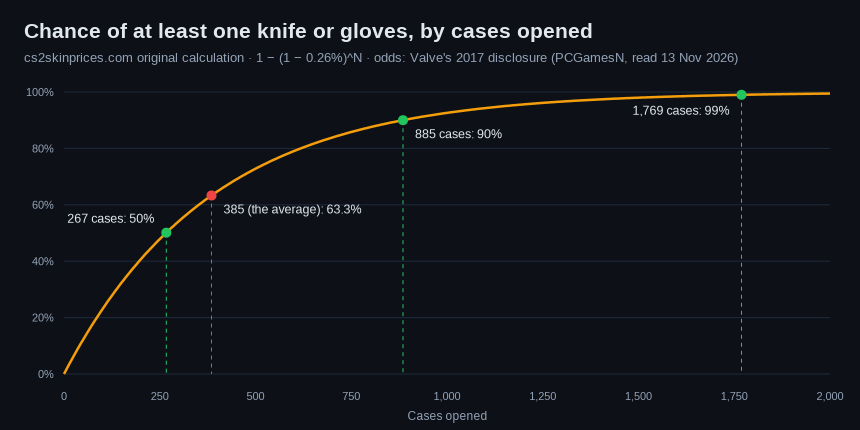
267 cases. That is how many cases to get a knife (or gloves) in CS2 with a 50% chance, using the gold odds Valve disclosed: 0.26% per open. For a 90% chance it is 885 cases, and for 99% it is 1,769. At the $2.49 key price, 267 opens cost $664.83 in keys alone, before you pay for a single case.
The calculator below does the same sum for any number of cases, any odds and any case in this site's price feed: the chance of at least one gold, the chance of none, the chance of two or more, and the cost. The rest of the page is the maths behind it, laid out in tables: cases needed for every target chance, why the often-quoted 385 is not the number you want, whether a gold in 100 cases is realistic, how rare back-to-back gold really is, and what those opens cost next to simply buying a knife. If you want the full tier-by-tier odds table (blue to gold), it lives on the CS2 case opening odds page; this page is about the count.
How many cases to get a knife: calculator
Gold = knife or gloves. Default odds are Valve’s disclosed 0.26% per open; every open is independent.
- Chance of at least one gold in 100
- 22.92%
- No gold at all
- 77.08%
- Two or more
- 2.83%
- Cost of 100 opens at $2.55 each ($2.49 key + $0.06 case)
- $255.00
| Target chance | Cases needed | Cost at $2.55/open |
|---|---|---|
| 50% | 267 | $680.85 |
| 90% | 885 | $2,256.75 |
| 99% | 1,769 | $4,510.95 |
On average one gold every 385 opens, but that average is not a promise: at 385 opens the chance is 63.30%.
Case prices: lowest listing in the cs2skinprices.com price feed, November 22, 2026. The key price is the in-game store price for US accounts; change it if yours differs. This shows chances, not a way to win them.
The odds behind the calculator, and what Valve did not disclose
Everything here rests on one number, so it is worth being exact about where it comes from. A Chinese Ministry of Culture rule from earlier in 2017 required games with loot boxes to publish drop probabilities, and when CS:GO launched officially in China, Valve's local partner Perfect World published them for its cases. PCGamesN reported the disclosure on 11 September 2017. Perfect World gave the odds as ratios between tiers, and the top-voted community reading of those ratios, which PCGamesN reproduced, turns them into percentages: out of 125.12 opens, 100 blue, 20 purple, 4 pink, 0.8 red and 0.32 gold. That gives the familiar figures: 79.92%, 15.98%, 3.20%, 0.64% and 0.26%. The same disclosure said any item has a 10% chance of being StatTrak™.
Three honest caveats. First, Valve has not republished these numbers on its own English-language pages, and the original was a Chinese announcement read through a translation. They are the disclosed figures, used everywhere because they are the only official ones. Second, 0.26% is a rounding: 0.32 ÷ 125.12 is 0.2558%. The difference is small but not zero, so the tables below give both where it shows. Third, the disclosure covers tiers only. It does not say how likely each individual knife or glove finish is within the gold tier, so nothing on this page tells you the odds of one specific knife.
The other fact the maths needs is that every open is independent. The disclosure gives a fixed chance per open and describes nothing that builds up over time, so there is no pity timer: a case opened after 300 dry ones has the same 0.26% as the first. That is what makes the formula below valid.
With a fixed chance p per open, the chance of no gold in N opens is (1 − p)N, so:
- Chance of at least one gold in N opens = 1 − (1 − 0.0026)N
- Cases needed for a target chance t = ln(1 − t) ÷ ln(1 − 0.0026), rounded up
That is all the calculator does. You can change the odds field to 0.2558 to use the unrounded figure, or to anything else if you are checking a different container.
Cases needed for every target chance
This is the table the question "how many cases to get a knife" actually needs. Pick the chance you would accept and read across. The key cost column uses $2.49 per key, the in-game price for US accounts, and leaves out the cases themselves.
| Chance of at least one gold | Cases at 0.26% | Cases at 0.2558% | Keys at $2.49 |
|---|---|---|---|
| 10% | 41 | 42 | $102.09 |
| 25% | 111 | 113 | $276.39 |
| 50% | 267 | 271 | $664.83 |
| 63.2% | 384 | 391 | $956.16 |
| 75% | 533 | 542 | $1,327.17 |
| 90% | 885 | 900 | $2,203.65 |
| 95% | 1,151 | 1,170 | $2,865.99 |
| 99% | 1,769 | 1,799 | $4,404.81 |
Read the shape rather than the single row. Doubling your chance from 25% to 50% takes 156 more opens. Going from 50% to 90% takes 618 more. Going from 90% to 99% takes another 884, as many as it took to reach 90% in the first place. The curve in the chart flattens because each extra case only helps the players who have not hit gold yet, and there are fewer of them the further you go. Nothing ever reaches 100%: even 2,000 opens leave a 0.55% chance of no gold at all.
The case on top of the key changes the bill more than it changes the shape. On the 22 November 2026 refresh of this site's price feed the cheapest listing for a Kilowatt Case was $0.06 and for a Chroma 3 Case $2.40, so the case adds anything from a few cents to roughly the price of a second key to every open. The cost-per-open page prices each tracked case, and the calculator above picks those prices up automatically when you choose a case.
Why 385 cases is the wrong answer to the right question
Many guides answer this question with 385, and the arithmetic behind that is right as far as it goes: 1 ÷ 0.0026 = 384.6, so on average one gold turns up per 385 opens. But an average is not the same as a typical result, and here the two are far apart.
The number of opens until the first gold follows what statisticians call a geometric distribution. It is lopsided: lots of players hit early, and a long tail of players go on and on. That long tail drags the average up. The middle player, the median, needs only 267 opens, while the average sits at 385 because of the unlucky few who need 1,000 or 2,000.
| Statistic | Opens | What it means |
|---|---|---|
| Median | 267 | Half of all players have their first gold by here |
| Mean (average) | 385 | Total opens ÷ total golds across everyone |
| Chance of gold by 385 opens | 63.3% | Not 100%, and not 50% |
| Chance of no gold by 385 opens | 36.7% | More than one in three players |
So "you need about 385 cases" overstates what the typical player needs for an even chance and, at the same time, promises far too much to the person who opens exactly 385: more than a third of them get nothing. The second half of that is the expensive misunderstanding. 385 opens at $2.49 is $958.65 in keys, and a 36.7% chance of walking away with no knife for it.
The same independence also kills the idea of being "due". If you have opened 200 cases without gold, your chances from here are exactly those of a new player: 267 more for a 50% chance, not 67. The past opens are spent. The case opening odds page covers that trap in more detail.
Is it possible to get a gold in 100 cases?
Yes, it is possible, and it is not even rare: 1 − 0.9974100 = 22.9%, so a bit under one player in four who opens 100 cases gets at least one knife or pair of gloves. The flip side is the 77.1% who get none. For a fuller picture, this table splits 100, 385 and 1,000 opens by how many golds come out, using the binomial distribution at 0.26%.
| Golds | In 100 opens | In 385 opens | In 1,000 opens |
|---|---|---|---|
| 0 | 77.08% | 36.70% | 7.40% |
| Exactly 1 | 20.09% | 36.84% | 19.30% |
| Exactly 2 | 2.59% | 18.44% | 25.13% |
| Exactly 3 | 0.22% | 6.14% | 21.79% |
| 2 or more | 2.83% | 26.46% | 73.30% |
| Keys at $2.49 | $249.00 | $958.65 | $2,490.00 |
Smaller batches, for scale: 10 opens give a 2.57% chance, 25 give 6.30% and 50 give 12.21%. If you open a handful of cases from weekly drops now and then, you should expect never to see gold from them, and be pleasantly surprised if you do.
One more number puts 100 cases in context. Even the player who does get a gold from 100 opens has paid $249 in keys, plus the cases, for whichever knife or gloves the case happened to give. That item is a random draw from the case's gold pool and a random wear, and many come out worth less than the keys spent. The section after next does that comparison.
How rare is back-to-back gold?
Back-to-back gold, two golds from two consecutive opens, is the clip everyone remembers, so it is worth pricing properly. There are three different questions hiding in "how rare is it", with very different answers.
| Question | Formula | Answer |
|---|---|---|
| I just unboxed gold. Is the next case gold too? | p | 0.26%, the same as any open |
| Two specific opens, both gold | p² | 0.000676%, 1 in 147,929 |
| Three specific opens, all gold | p³ | 1 in about 56.9 million |
The first row is the one people get wrong in both directions. A gold does not make the next one less likely ("you've used up your luck") or more likely ("the case is hot"). The next open is 0.26%, full stop. The second row is the chance of the clip before either case is opened: 0.0026 × 0.0026 = 0.00000676, or one in 147,929 pairs of opens.
The third question is the one behind the clips: if someone opens a lot of cases, how likely is it that a back-to-back pair turns up somewhere in the run? That needs a slightly longer calculation (tracking whether the previous open was gold, open by open), and gives:
| Opens in the run | Chance of at least one back-to-back gold pair |
|---|---|
| 100 | 0.067% |
| 385 | 0.26% |
| 1,000 | 0.67% |
| 10,000 | 6.5% |
So for a regular player it is a once-in-many-lifetimes event, while a streamer who opens tens of thousands of cases on camera will see it now and then. Huge numbers of people open cases, which is why clips of it exist at all; the clips do not mean the odds are better than 1 in 147,929.
What N cases cost next to buying a knife
The last question behind "how many cases to get a knife" is whether to open them at all, and the numbers from the tables above make that straightforward to frame. Reaching a 50% chance costs $664.83 in keys, and a 90% chance costs $2,203.65, before cases. The cheapest knives on the market cost a small fraction of that: on the 22 November 2026 refresh, a Field-Tested Navaja Knife | Safari Mesh was listed from $33.35 and a Field-Tested Kukri Knife | Safari Mesh from $33.45. The cheapest knife in CS2 page tracks that floor across every family.
An illustrative example makes the gap concrete. A player sets aside $100 for knife hunting. As keys, that is 40 opens (40 × $2.49 = $99.60, cases extra), which gives a 9.9% chance of any gold at all, from a pool they do not choose, in a wear they do not choose. As a purchase, it buys a cheap knife outright today, with change left over. The case route only wins for the roughly one player in ten who hits, and only if the gold that drops is worth more than a budget knife.
That does not make opening cases wrong. It makes it entertainment with a price, and the price per open is the key plus the case. If you open for fun, set the budget first, use the calculator to see what that budget buys in probability, and treat any gold as a bonus. If you want a specific knife, buy that knife. The are CS2 cases worth opening page works through the expected value of a real case, item by item; why CS2 knives are so expensive explains why the 0.26% is what holds knife prices up; and the CS2 cases hub links every case guide on the site. For live prices on everything mentioned here, start from the cs2skinprices.com homepage.