How Do CS2 Drops Work? The Free-Items System Explained

Sukie · Founder & Market Tracker
Sukie has tracked the Counter-Strike skin economy since 2023, maintaining a price-history spreadsheet that covers 400+ skins and testing every major marketplace with her own inventory. She writes and updates every guide on CS2 Skin Prices herself.
Last updated: 2026-08-20
How do CS2 drops work? In plain terms: play matches, earn XP, and once per week the game hands you a free item when you level up — plus, if you own an Armory pass, you steadily earn stars you can redeem for a second stream of items. That is the whole system in one sentence, but the details underneath it decide whether your drops are worth a few cents or occasionally something much better.
I have been logging every drop my own account receives since March 2025, partly out of curiosity and partly because readers kept asking whether "free skins" amount to anything. The answer is yes, but modestly — and understanding the mechanics helps you avoid the two classic beginner mistakes: expecting drops to fund an inventory, and accidentally leaving Armory stars unredeemed. This guide walks through each drop type, what the active pool contains, why the old cases you see selling for real money no longer drop, and what a year of casual play realistically pays.
The Weekly XP Drop, Explained
Counter-Strike 2 — free to install on Steam — awards XP for playing almost any mode: Competitive, Premier, Casual, Deathmatch, and the rest. Fill the XP bar, and your profile ranks up. The first time you level up in a given week, you receive one item drop. That is the core rule worth memorizing: one drop per week, triggered by your first level-up of that week, with the week resetting on Valve's weekly maintenance schedule. When people ask how do CS2 drops work, nine times out of ten this weekly item is the part they mean.
What arrives is random within the active pool: usually a low-value graffiti or a consumer-grade skin, sometimes a case from the active drop pool, occasionally something mid-tier. You do not need to win the match, and you cannot bank multiple weeks — skip a week and that drop is simply gone. The practical takeaway for a casual player is that a single session per week captures the entire weekly entitlement. Grinding forty hours captures no more of it than grinding four.
One detail worth knowing: reduced-XP thresholds for extremely heavy play can slow leveling, but for anyone playing normal hours they are irrelevant.
The Armory Pass: The Second Stream
The Armory is the paid track Valve added in 2024. You buy an Armory pass, earn stars through playtime, and spend those stars on your choice of rewards — Armory redemptions are the only drop-like stream where you pick what you get. The menu has included Armory-exclusive cases, skin collections, charms, and stickers, and it rotates as Valve updates the game.
Redemptions matter for two reasons. First, choice: instead of praying the random pool hands you something decent, you point your stars at the specific case or collection you want. Second, the Armory has been Valve's main lever for injecting new item types into the economy — several of the most-traded cases of 2025-2026 entered the game exclusively through Armory redemption. When I priced out my own pass in early 2026, the items I redeemed were worth modestly more on the market than the pass cost me — but that math depends entirely on current prices and which rewards you pick, so treat it as something to check at purchase time, not a rule.
The beginner mistake I see most: buying a pass, earning stars, and forgetting to actually redeem them before moving on from the game. Stars are not an inventory item you can sell — their value only materializes when you spend them.
What Is in the Active Drop Pool Right Now
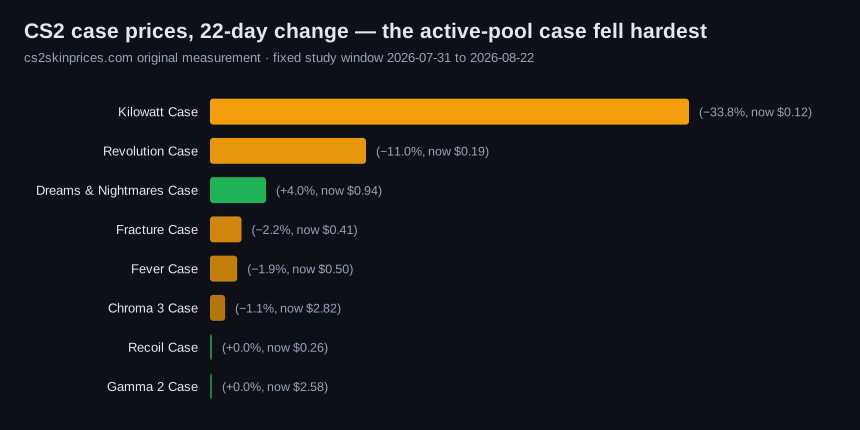
Only a rotating subset of items can drop from the weekly XP system, and Valve adjusts that subset without much ceremony. As of mid-2026 the pool contains recent case releases, a set of older-but-not-retired cases, and a spread of low-tier weapon finishes from active collections. The exact list shifts, which is precisely the point: which cases sit in the active pool is one of the biggest price inputs in the entire skin economy.
Here is the full drop landscape in one table, with hedged mid-2026 values from my own tracking:
| Drop type | What you get | How often | Typical market value (mid-2026, approximate) |
|---|---|---|---|
| Weekly XP drop | Random item from active pool: graffiti, low-tier skin, or a case | Once per week, first level-up | A few cents to a few dollars; occasionally more |
| Armory redemption | Your choice from the Armory menu: cases, collections, charms | As you earn stars (paid pass required) | Varies by choice; roughly pass-price or somewhat above if redeemed shrewdly |
| Case drop pool (subset of weekly drop) | A sealed case from the currently active rotation | Some weeks, luck-dependent | Often under $1; older rotation cases can run higher |
| Souvenir drops at Majors | Souvenir packages tied to pro matches during a Major | Only during Major events, viewing-linked | Highly variable — often a few dollars, with rare standouts |
Why Old Cases Stopped Dropping — and Got Expensive
Every case you see selling for meaningful money was once a common drop. When Valve rotates a case out of the active pool, its supply is effectively frozen: existing copies keep getting opened and destroyed, no new copies enter, and scarcity does the rest. This is the single mechanism behind the 2024-2025 case bull run, when discontinued cases became the market's hottest category.
It is also behind the sharpest shock in recent memory. In October 2025, Valve updated the drop pool in a way that returned some previously scarce cases to circulation — and I watched rows of my spreadsheet turn red in real time as items repriced 25-40% downward over about six weeks. Prices later stabilized and much of the market recovered through spring 2026, but the lesson stands: a case's price rests on its drop status, and Valve can change that status any Tuesday it likes.
For a beginner, the practical version is this: the cases dropping into your inventory today are nearly worthless because everyone is receiving them, and the expensive ones on the market are expensive because nobody receives them anymore. Whether opening either kind ever makes sense is a different question — the odds are 0.64% for a Covert and 0.26% for a gold — and I break that math down in CS2 case opening odds.
Souvenir Packages at Majors
The fourth drop type only exists during Major championships, the biggest events on the professional calendar (schedules and results live on HLTV). During a Major, watching or engaging with the event through the game can award souvenir packages — special containers holding souvenir versions of skins from the maps played, stamped with event and team stickers.
Souvenir items occupy a strange corner of the economy. Most souvenir pulls are low-tier finishes worth a few dollars at best. But because souvenir versions of certain skins on certain maps are genuinely rare, a lucky package can contain something worth real money — souvenir AWP Dragon Lore pulls from Cobblestone packages are the famous historical example, trading for five figures. Nobody should watch a Major expecting that outcome; it is the lottery-ticket tail of a distribution whose median is a couple of dollars.
My own log makes the point: across the two Majors I watched in 2025, my packages sold for a combined total of about $9. If you enjoy the events anyway — and Majors are genuinely great viewing — the packages are a pleasant bonus rather than a reason to tune in.
Turning Drops Into Money: A Year of Casual Play, Priced
Everything the drop system gives you (except Armory stars themselves) is a real, sellable item. List it on the Steam Community Market and the proceeds land in your Steam wallet, minus the 15% total fee; sell through third-party marketplaces and you can reach actual cash, with different fees and trade-offs. The step-by-step of both routes, including hold periods and pricing tactics, is in how to sell CS2 skins.
So what is a year of drops actually worth? From my own log, March 2025 to March 2026: 41 weekly drops captured (I missed eleven weeks), which sold for a combined total of roughly $19 — a median drop value of well under fifty cents, with two cases from the rotation accounting for almost half the total. Add my Armory redemptions, which netted modestly more than the pass cost, and the whole year of "free items" came to something like $30-40 of realizable value. Your numbers will differ with luck and the rotation, but the order of magnitude is the honest answer.
That is the right frame for a beginner: drops are a slow trickle that funds a modest first skin, not an inventory. If you are ready to turn that trickle into a deliberate first purchase, start with the beginners hub and the CS2 skin prices homepage for price context before you spend a cent.
Frequently asked questions
How many drops can you get per week in CS2?
One weekly XP drop, awarded the first time you level up that week. Armory redemptions are separate and depend on stars earned through playtime with a paid pass, and souvenir packages only exist during Major events. There is no way to earn a second weekly XP drop by playing more.
Do you need Prime status to get drops?
Weekly XP drops are tied to leveling, which any account does by playing, though Valve has adjusted entitlement details over time — check the current rules in-game. The Armory requires purchasing a pass regardless of Prime status.
Can you get a knife from a CS2 drop?
Not directly from the weekly drop — knives come from opening cases, not from the drop itself. A dropped case could theoretically yield a knife if you buy a key and open it, but at 0.26% odds for the gold tier, that is an expensive long shot rather than a plan.
How do CS2 drops work if I miss a week?
The drop is simply forfeited. There is no banking, stacking, or catch-up mechanic — each week's entitlement exists only in that week. If drops matter to you, one short session per week is enough to capture every one.
Are dropped skins tradable and sellable right away?
Dropped items can generally be listed on the Steam Community Market, though newly acquired items face short trade-hold windows depending on how they were obtained and your account's security settings. Steam wallet funds from sales can never be withdrawn as cash — only third-party marketplaces get you to real money.
Why are my drops worth so little?
Because everyone playing receives items from the same active pool, supply is enormous and prices stay near the floor. Value in this economy comes from scarcity — retired cases, rare finishes, low floats — and by design, nothing currently dropping is scarce. My own year of weekly drops totaled roughly $19.
Do Armory stars expire, and can I sell them?
Stars are not marketable items — you cannot list or trade them, and their value only becomes real when you redeem them for items. Redeem before you drift away from the game; unspent stars are the most common way players silently waste the money they put into a pass.
What was the October 2025 drop-pool change?
Valve adjusted which cases were in active circulation, returning supply to some items the market had priced as scarce. Prices in the affected categories fell sharply — my tracking showed 25-40% drawdowns over about six weeks — before stabilizing and largely recovering through spring 2026. It remains the clearest demonstration that drop status drives case prices.
Is buying an Armory pass worth it?
Sometimes, narrowly. When I ran the numbers on my own pass in early 2026, redeeming the most liquid rewards returned modestly more than the pass cost — but that margin shifts with market prices and reward rotations. Price the current redemption options against the market before buying, and never count on profit.